What NFT Certificates Actually Prove - and What They Don't
An NFT certificate proves that a specific token exists on a blockchain and which wallet controls it, but it does not automatically prove identity, skill, legal rights, or that any employer will accept it. If you have wondered whether an NFT certificate is a real credential or a fancy digital sticker, that confusion is reasonable, because most explanations skip the part that decides the answer.
Key Takeaways
- An NFT certificate is a blockchain token used to represent a credential, such as a course completion, an event attendance, or a certificate of authenticity.
- The blockchain layer can prove that a token exists, which contract issued it, and which wallet holds it now. It cannot prove the claim inside the certificate is true.
- Wallet control is not the same as identity, and a token on-chain does not transfer copyright, guarantee employer recognition, or make a course rigorous.
- The useful question is not "is it an NFT" but "who issued it, what was required to earn it, will the data survive, and who recognizes it."
- Verifying an NFT certificate means checking the issuer, the contract, the metadata, the holder, and the recognition context, not just seeing a token in a wallet.
NFT certificates sit in an awkward gap. They sound technical enough to seem trustworthy, yet most people cannot say what one actually proves. That gap is where bad assumptions grow, and it is the exact problem this article is built to close. At Blockready, we teach credential literacy the same way we teach everything else: understand the mechanism first, then decide what to trust. The proof stack below is the framework we use to separate what the blockchain genuinely confirms from what still depends on an issuer, an identity, and a verifier.
What an NFT certificate actually is
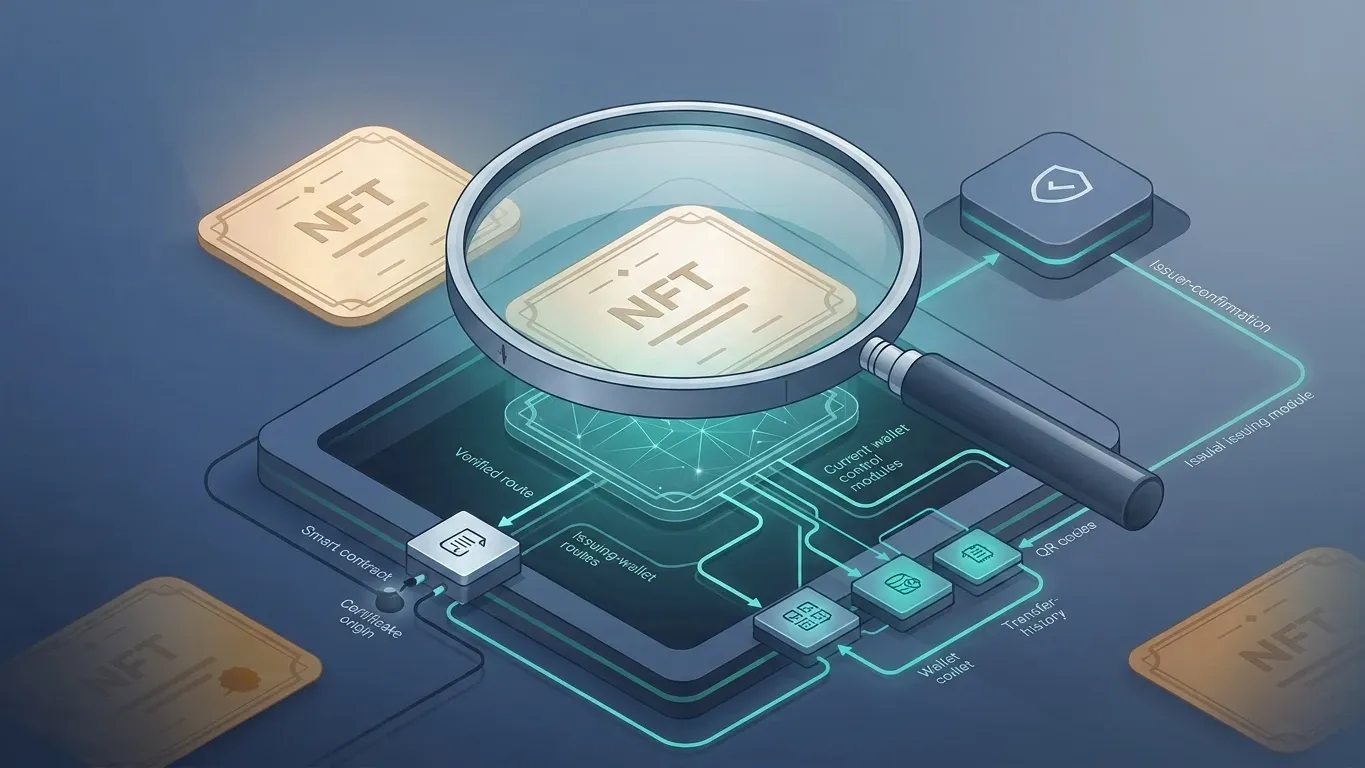
An NFT certificate is a non-fungible token used as a digital credential, such as a course-completion record, an event badge, a membership pass, or a certificate of authenticity for a physical or digital item. It usually combines a blockchain network, a smart contract, a token ID, a wallet address, certificate metadata, an issuer, and a verification path. Each of those parts does a different job, which is why a single yes-or-no answer about what it "proves" almost always misleads.
NFT Certificate
An NFT certificate is a blockchain token that points to a credential claim made by an issuer, such as "this person completed this course." It can be checked on a public ledger, and it stays under the control of whichever wallet holds it.
Simple version: the token is the container. The credibility comes from who filled it and who accepts it.
It also helps to clear up a naming problem early. An NFT certificate is not the same as an "NFT certification." An NFT certificate is a credential stored as a token. An NFT certification is usually a professional course about NFTs, sold by a training provider. They share words and almost nothing else. If you are researching credentials, that distinction saves a lot of wasted clicks. For the underlying token mechanics, our explainer on what NFTs actually are and how they work covers the foundations this article builds on.
The proof stack: what each layer can and cannot prove
The clearest way to think about an NFT certificate is as a stack of layers. Each layer answers a different question, and each one gets weaker as you move from the on-chain record toward real-world meaning. The blockchain is strong at the bottom and silent at the top.
The NFT Certificate Proof Stack
Proof strength is highest at the token layer and lowest at recognition. Read each layer as what it can confirm, and what it leaves open.
Layer 1
Token layer
A block explorer can confirm the token exists, its ID, the contract that minted it, and the wallet that holds it now. It cannot confirm who that wallet belongs to.
Verifiable on-chainLayer 2
Metadata layer
The token points to the certificate details: the course name, the date, the recipient, an image. Whether those details survive depends on how and where they are stored.
Depends on storageLayer 3
Issuer layer
You can see which wallet or contract issued the token. You still have to confirm that wallet truly belongs to the organization it claims to represent.
Needs confirmationLayer 4
Identity layer
Holding the certificate proves wallet control, not that the holder is the person who earned it, especially when the certificate can be transferred to another wallet.
Not proven by the tokenLayer 5
Recognition layer
Whether the certificate counts for anything depends on an employer, school, or professional body choosing to accept it. The token format does not create recognition.
Depends on the verifierLayer 6
Durability layer
The on-chain record may last for years, but off-chain metadata, image hosting, and the issuer's verification page can disappear if nobody maintains them.
Depends on the platformFramework: Blockready educational synthesis, informed by the ERC-721 standard, the W3C Verifiable Credentials Data Model 2.0, and Open Badges 3.0.
What NFT certificates can prove
The bottom of the stack is where blockchains earn their reputation. The ERC-721 standard, the most common standard for these tokens, includes an ownerOf function that returns the wallet address currently holding a given token. So an NFT certificate can show, in public and without asking anyone's permission, that a token exists, which contract created it, and which wallet controls it today. A public minting event also makes quiet edits hard, because changing the record would leave its own trace.
That is genuinely useful. A traditional PDF can be copied and altered in minutes, while an on-chain record is tamper-evident: changes tend to show up rather than hide. The standard also defines an optional metadata extension, so the token can point to the certificate's details. The key word is optional. ERC-721 does not require metadata at all, which is why two certificates that look identical can behave very differently depending on how they were built.
What NFT certificates do not prove
Here is where most marketing language quietly overreaches, and where a credential reader needs to slow down. If you have ever felt unsure about putting an NFT certificate on a CV or LinkedIn profile, that hesitation is healthy. The honest reason is that several things people assume are proven are not.
First, the certificate does not prove identity. A wallet can be shared, sold, lost, or controlled by someone other than the learner, so wallet possession is not the same as being the person named in the credential. If you are unclear on what a wallet does and does not establish, our guide to what a crypto wallet actually controls is a useful companion.
Second, verifying a certificate is not the same as verifying its claim. This is the single most important idea in the whole topic, and it is not a marketing line. The World Wide Web Consortium published version 2.0 of its Verifiable Credentials Data Model as a formal Recommendation on 15 May 2025, and it draws the line plainly: confirming that a credential is authentic does not mean the claims inside it are true. A perfectly valid token can still carry a worthless or false claim if the issuer was careless or dishonest.
Third, owning the token does not transfer legal rights. In a joint report to Congress on 12 March 2024, the United States Patent and Trademark Office and the United States Copyright Office noted that buyers frequently and wrongly assume that purchasing an NFT gives them the intellectual property rights in the linked work. Their joint study on NFTs and intellectual property stresses that the rights you get depend on the contract or license the issuer offers, not on the token by itself.
Fourth, the certificate does not guarantee that its data will last forever. NFT metadata is often stored off-chain, and on networks like IPFS, data is not automatically permanent. The official IPFS documentation explains that data must be pinned to one or more nodes or it can be removed during routine cleanup. A permanent token does not guarantee a permanent certificate.
The Core Idea
Verifying an NFT certificate tells you the record is real. It does not tell you the claim inside it is true. Those are two separate checks, and most confusion comes from collapsing them into one.
NFT certificates versus other digital credentials
NFTs are not the only way to issue a digital credential, and they are not automatically the best one. It helps to compare the format you are looking at against the alternatives, because each handles verification, durability, and identity differently.
NFT Certificate vs PDF vs Verifiable Credential or Open Badge
Framework: Blockready educational synthesis, based on the standards cited in this article. Comparison is general; specific implementations vary.
The Open Badges 3.0 standard, maintained by 1EdTech, is worth knowing about here. Open Badges 3.0 are now built as W3C Verifiable Credentials and carry structured fields for the issuer, the criteria a learner had to meet, and supporting evidence. That is the part many NFT certificates leave out. A token can be unique and still tell you nothing about what the learner actually did to earn it.
How to verify an NFT certificate before you trust it
If someone hands you an NFT certificate, or you are deciding whether to claim one, the proof stack turns into a short checklist. The goal is to move from "there is a token" to "I know who issued it and what it means." This is also where good verification habits overlap with scam awareness, since fake collections and lookalike contracts use the same tricks. Our breakdown of how fake NFT collections and mint pages work goes deeper on the patterns to watch.
Verifying an NFT Certificate: A Six-Step Check
Framework: Blockready educational synthesis based on the verification practices described in this article.
This is not just theory. Blockready issues its own course-completion NFT certificate on the Polygon network, delivered to the learner's own wallet, and the verification steps it gives to employers mirror the checklist above: look up the wallet on a block explorer and confirm the certificate was transferred from the official issuing wallet. That issuing-wallet check is the practical version of the issuer layer, and it is the step most casual viewers skip.
When an NFT certificate makes sense, and when it does not
An NFT certificate is a reasonable choice when an issuer wants a public, tamper-evident, portable record that a learner can carry across platforms, and when the issuer is willing to design durable metadata and a real verification page. It is a weaker choice when the credential needs strong privacy, reliable identity binding, or recognition from institutions that have no process for reading on-chain data. For many credentials, a Verifiable Credential or Open Badge does the same job with better identity and evidence handling, and without asking the holder to manage a wallet.
None of this means NFT certificates are hype or worthless. It means the format is one design choice among several, and the value sits in the choices around it. Blockready's own curriculum covers NFTs in Module 12, including their valuation drivers and legal implications, precisely because the legal and recognition questions are where beginners get the most confused. If you want to evaluate any credential, not just an NFT one, our framework for how to evaluate blockchain certifications is a good next stop.
Our view, based on how we sequence credential literacy in our curriculum, is that the format of a certificate matters far less than four things behind it: who issued it, what the learner had to do to earn it, whether the record is durable, and who actually recognizes it. We do not recommend treating an NFT certificate as proof of skill or as automatically employer-recognized, because the blockchain layer verifies the record, not the achievement behind it. The W3C standard for verifiable credentials makes the same point in plain terms. An NFT certificate can be useful evidence of completed learning. It is not a shortcut around the harder question of whether the learning was real and whether the issuer is credible. If you are early in your journey, our guide on a structured path for learning crypto puts credentials in their proper place: late, after understanding.
Frequently Asked Questions
What does an NFT certificate prove?
An NFT certificate proves that a specific token exists on a blockchain, which contract issued it, and which wallet holds it. It does not prove the holder's identity, the truth of the claim it carries, or that any institution recognizes it.
Can NFT certificates be faked?
Yes. Anyone can mint a token and label it a certificate, create a lookalike contract, or copy an issuer's branding. The blockchain makes the record tamper-evident, but it does not stop a false certificate from being issued, which is why confirming the official issuing wallet matters.
Does owning an NFT certificate mean you own the copyright?
No. Owning the token does not automatically transfer copyright or commercial rights. The US Patent and Trademark Office and US Copyright Office noted in their March 2024 joint report that the rights attached to an NFT depend on the issuer's contract or license, not on holding the token.
Can employers verify NFT certificates?
Yes, if the issuer designed it to be verifiable. An employer can look up the holder's wallet on a block explorer and confirm the certificate came from the issuer's official wallet. What an employer cannot do automatically is confirm the holder is the named person or judge whether the credential is meaningful.
What happens if the certificate's metadata disappears?
If the off-chain metadata is not stored durably, the token can survive while its details become unreadable. NFT data on networks like IPFS must be pinned to persist, so a poorly designed certificate can outlive the evidence it was meant to carry.
Is an NFT certificate the same as an NFT certification?
No. An NFT certificate is a credential stored as a blockchain token. An NFT certification is usually a professional training course about NFTs. The terms are often mixed up, but they describe different things, so it helps to confirm which one a provider means.
See the Learning Experience Before You Commit
Explore a live preview of Blockready's learning formats, from glossary-style explanations to interactive flashcards, lesson briefs, and curated research tools. No signup required.
Explore the Live Demo