
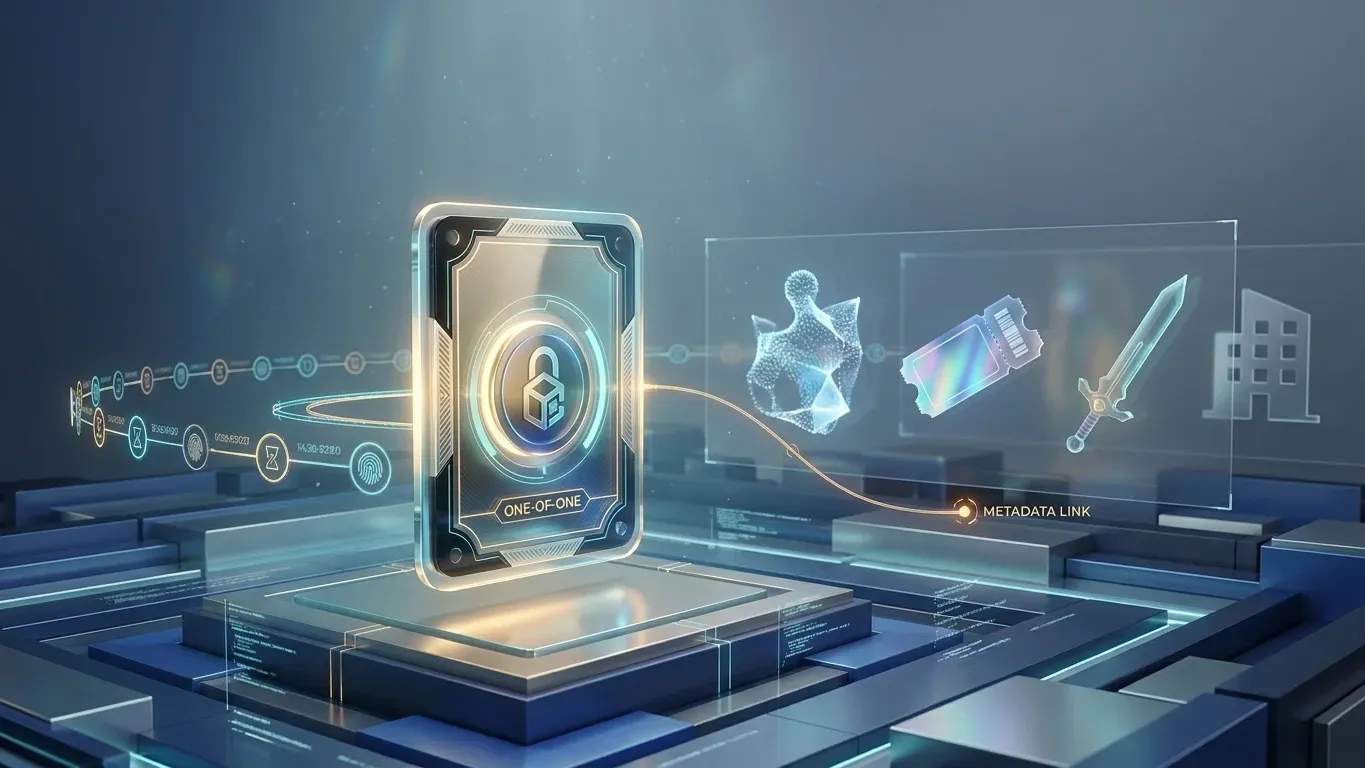
NFTs Explained: Definition, History, Types, and Use Cases for 2026
An honest 2026 guide to what NFTs are, how they actually work, the categories that still matter, and the history that got us here.
Key Takeaways
- An NFT is a unique digital identifier recorded on a blockchain that certifies ownership of a specific digital or physical asset.
- The first known NFT, Quantum, was created in May 2014, three years before CryptoKitties popularized the term.
- NFT trading peaked at roughly $17 billion in 2021, collapsed by over 90% in 2022, and stabilized at around $5.5 billion annualized volume in 2025.
- NFTs span 13 distinct categories beyond digital art, including event tickets, identity credentials, real estate records, gaming assets, and Bitcoin Ordinals.
- Owning an NFT does not automatically grant copyright to the underlying asset; legal rights depend on the specific license attached to the sale.
An NFT, or non-fungible token, is a unique digital identifier recorded on a blockchain that certifies ownership of a specific digital or physical asset. That sentence does most of the work, but it leaves a lot unsaid. What does "unique" really mean here? Why would anyone pay for a record of ownership when the file itself can be copied? And what's left of NFTs in 2026, four years after the market collapsed and three years after most headlines went quiet?
This guide answers those questions plainly. We'll walk through the definition, the mechanics, the major categories, the history, and the honest current state. No hype reversal, no doom narrative. Just the parts that matter if you want to actually understand what you're looking at.
Why NFTs exist: the unique-digital-thing problem they solve
For most of the internet's history, digital files have been infinitely copyable at zero cost. A JPEG of the Mona Lisa is identical to every other copy of that same JPEG. There was no native way to say "this specific file is the original" or "this person owns it" without trusting a central authority. Centralized platforms solved this through accounts and databases: Spotify decides who has access to what song, Steam decides who owns which game, your bank decides who owns which dollars in which account.
NFTs propose a different approach. Instead of trusting a single company's database, ownership is recorded on a public blockchain that anyone can verify. The token itself is a unique identifier that points to a specific asset, and the blockchain tracks every transfer of that token from creator to current owner. The promise is straightforward: a way to establish provable ownership of something digital without needing a central gatekeeper.
Whether that promise has been delivered consistently is a separate question. We'll get to that later in the post. But the underlying idea, the thing NFTs are trying to solve, is genuinely interesting and worth understanding before forming an opinion about the market.
How NFTs actually work: smart contracts, minting, and metadata
The mechanism behind NFTs is simpler than the surrounding noise suggests. Three pieces matter: the smart contract, the minting process, and the metadata.
The minting process step by step
Minting is the act of creating an NFT. It happens through a smart contract, which is a self-executing program stored on a blockchain. When a creator wants to mint an NFT, they call a function on a smart contract that follows a token standard. The most common standard on Ethereum is ERC-721, which was finalized in June 2018. The contract assigns the new token a unique ID, links it to a metadata record, and registers the creator as the owner. From that moment on, the token exists, and every transfer of it is recorded on the blockchain forever.
If this sounds abstract, the easiest way to understand it is to compare it to a deed for a house. The deed itself is just a piece of paper, but it carries legal weight because it's registered with a public authority and contains a unique description of the property. An NFT works the same way, except the public authority is a blockchain network and the registration is automated by the contract code. To go deeper on how this kind of programmable agreement works at the technical level, our explainer on how blockchain technology operates covers the underlying mechanics.
On-chain vs off-chain metadata, and what link rot means for you
Here's a detail most beginner explainers skip. The token lives on the blockchain, but the asset it points to usually doesn't. A typical NFT contains a token ID, the owner's wallet address, and a URI, which is a link pointing to a metadata file. That metadata file describes the asset, including its name, attributes, and a link to the actual image, video, or audio file. Both the metadata and the underlying asset are commonly stored off-chain, on services like IPFS or, in some cases, on regular web servers.
This creates a real problem called link rot. If the server hosting the metadata or the asset goes down, the NFT keeps existing on the blockchain, but the thing it points to becomes inaccessible. You'd still own the token, but the image it represents could disappear. Some projects mitigate this by storing metadata fully on-chain or pinning it to decentralized storage networks, but plenty of NFTs from the boom years are pointed at servers that may not exist in a decade. It's one of the most quietly serious risks in the space, and worth knowing about before you assume that "on the blockchain" means "permanent."
Why some NFTs need to be wrapped
Older NFT projects sometimes pre-date the standards that modern marketplaces support. CryptoPunks, for example, were minted in June 2017, before ERC-721 even existed. To trade them on contemporary marketplaces, owners typically wrap them, which means depositing the original token into a smart contract that mints a new ERC-721-compatible token representing it. The original Punk is locked in the wrapper contract, and the wrapped version becomes the tradable representation. This is a small, technical detail, but it tells you something important: the token standards have evolved, and not every NFT works the same way under the hood.
NFT vs cryptocurrency: a clean comparison
The most common confusion in this space is between NFTs and cryptocurrencies. They both live on blockchains, they both use wallets, and they're often discussed in the same breath. But they solve different problems and behave very differently.
NFTs VS CRYPTOCURRENCY
Sources: Ethereum Foundation, Bitcoin Wiki, Blockready Module 1
The shorthand version: cryptocurrency is for value, NFTs are for identity. Bitcoin and Ether are designed to be interchangeable so they can function as money. NFTs are designed to be unique so they can function as ownership records. Same underlying technology, completely different design intent.
A short history of NFTs: from Quantum to 2026
Most articles you'll read date NFTs to 2017 with CryptoKitties or to 2021 with Beeple. Neither is right. The actual history runs longer and is more interesting than the highlight reel suggests. For the broader chronology of digital money and crypto more generally, we cover that in our history of cryptocurrencies piece. NFTs are one branch of that larger story.
NFT MAJOR MILESTONES, 2012 TO 2026
Sources: Wikipedia, The Block, Wall Street Journal, court filings, Christie's, Nifty Gateway
If you read that timeline carefully, a few things stand out. The cultural pivot point most people remember (Beeple, March 2021) sat almost a decade after the underlying experimentation began. The peak and the collapse happened within roughly 12 months of each other. And the most consequential developments of 2025 and 2026 weren't market events. They were legal and regulatory closures that quietly shifted the ground for what NFTs can be used for going forward.
The 13 categories of NFTs
Most beginner guides bucket NFTs into four categories: art, collectibles, gaming, and real estate. That framing is too coarse to be useful. The actual category landscape is broader, and the categories that matter in 2026 aren't the same as the ones that mattered in 2021.
THE 13 CATEGORIES OF NFTs
Source: Blockready research
You'll notice the categories don't sit at the same level of activity. PFP collections and 1-of-1 art carried the speculative weight in 2021 and have lost most of it. Gaming, tickets, identity, and real-world assets are quieter but growing. The shift is important: in 2026, the categories with momentum aren't the ones the headlines made famous.
What NFTs are actually being used for in 2026
The post-collapse phase of any technology cycle is where the actual use cases get tested. With NFTs, the test results are mixed but more interesting than the "NFTs are dead" framing suggests. A few use cases have moved from speculation to operational deployment.
Event ticketing. Coachella issued NFT VIP tickets for its 2024 festival, and FIFA built its Right-to-Buy World Cup 2026 ticketing program around blockchain-based passes. The benefits are concrete: counterfeit prevention, enforceable resale royalties, and a verifiable record of attendance that can become a memento. The challenges are equally concrete (Switzerland's gambling regulator opened a probe into FIFA's program in October 2025), but the underlying infrastructure works.
Phygital retail. Pudgy Penguins, originally a PFP collection, pivoted to physical products and placed plush toys in Walmart, Target, and Walgreens. The retail line generated over $13 million in sales and over a million toys sold by 2024, with each toy linked to a digital companion accessible via an NFT-adjacent system. It's the clearest case of NFT branding translating into mainstream retail revenue without the collector base evaporating.
Identity and credentials. Academic and professional credential issuance is one of the most promising NFT use cases, precisely because the technology's strengths (verifiable, non-transferable, tamper-proof) match the use case's needs. Blockready's NFT certificate program is one example of credentials issued on-chain rather than as a paper or PDF document, but the broader category extends to vocational certifications, university degrees, and professional licenses. Adoption is gradual rather than viral, which is what mature infrastructure tends to look like.
In-game ownership. Ubisoft re-entered the space in 2024 with Champions Tactics on Immutable's zkEVM, building NFTs into seasonal in-game items rather than treating them as the entire product. The model that survived isn't "play to earn" speculation; it's "play and own" mechanics, where assets exist as tradable items inside games designed to be fun first.
Real-world asset tokenization. Institutional interest in tokenizing real estate, treasury bills, and other RWAs has grown substantially. The category is closer to securities than collectibles, and most of it operates under structured legal frameworks rather than speculative trading floors. It's also where the institutional capital that left the JPEG market in 2022 has gradually returned.
Benefits NFTs deliver, and where they fall short
Honest accounting matters here. NFTs deliver some specific benefits and fail at others. Understanding the difference saves you from both the hype and the over-correction.
What NFTs do well. Verifiable provenance for digital assets. Programmable ownership rules embedded in the asset itself, which lets creators automate royalty payments on resale. Transferability without intermediary platforms. A single, public record of every transaction in the asset's history. For categories like academic credentials, event tickets, and licensed digital memorabilia, those properties solve real problems.
What NFTs don't reliably deliver. Permanence (link rot is a real failure mode). Copyright transfer (almost never automatic). Liquidity (most NFTs are very hard to sell quickly). Investment returns (the 2022 collapse demonstrated this clearly). Insurance against fraud, plagiarism, or platform failure. The mismatch between what NFTs were marketed as and what they actually are explains most of the disappointment from the 2021 cycle.
The pattern is recognizable. Every new technology gets oversold during its hype phase, and the limitations only become legible after the cycle peaks. NFTs went through that arc faster and more publicly than most. What's left is a smaller set of use cases where the technology is genuinely useful, and a much larger graveyard of projects that didn't have a reason to exist beyond speculation.
Risks: scams, link rot, IP confusion, and marketplace failure
If you decide to engage with NFTs as a buyer, creator, or even just an interested observer, a handful of risks deserve direct attention. None of these are exotic. They're patterns that have repeated thousands of times. Many of these mistakes overlap with broader patterns we covered in 10 crypto mistakes to avoid, but a few have NFT-specific shapes worth flagging directly.
Phishing and wallet drainers. The most common loss vector. A fake mint page or airdrop link prompts you to sign a transaction that drains your wallet. The mechanism is technical (malicious approval signatures) but the prevention is behavioral: never click unsolicited mint links, always verify URLs, and use a separate wallet for NFT activity that doesn't hold your main holdings.
Counterfeit collections. OpenSea has stated publicly that a significant share of minted NFTs on its platform are plagiarized or fraudulent copies of legitimate works. Verification is your responsibility: check the contract address against the official project source, not just the collection name shown on the marketplace.
Rug pulls. A project promises future development, collects mint revenue, and the team disappears. The Evil Ape rug pull in 2021 was the canonical case but far from the only one. The structural defense is to assume any anonymous team with locked liquidity rules can withdraw at will.
Link rot. Already covered above, but worth repeating in the risk frame. NFTs minted on platforms that later go offline can be left pointing at dead links. The token persists; the asset doesn't. Projects that store metadata on-chain or pin it to maintained decentralized storage are more resilient than projects that don't.
IP confusion. Buying an NFT does not, in most cases, transfer copyright. Some projects (Bored Ape Yacht Club) explicitly grant commercial rights to holders. Most don't. Reading the actual license attached to the project before assuming anything about your rights is unglamorous but critical. This is the kind of due diligence we cover in our framework for evaluating crypto projects, and it applies just as much to NFT collections as it does to token launches.
Are NFTs still relevant? An honest answer for 2026
Yes and no, depending on what you mean.
The market for speculative trading of profile picture collections is much smaller than it was in 2021. Most of those collections have lost the majority of their value, and a steady flow of price-recovery articles in early 2026 mostly reflects mean reversion in a small handful of blue-chip collections (CryptoPunks, BAYC, Pudgy Penguins) rather than a return to the broader bull market. The Block describes 2025 as another down year, with annualized trading volume around $5.5 billion, roughly 37% below 2024.
The market for NFTs as functional infrastructure (tickets, credentials, tokenized real-world assets, in-game ownership) is alive and growing, but it doesn't generate the same headlines because it doesn't operate on speculation. A blockchain-based ticket that prevents counterfeiting and enables royalty enforcement is genuinely useful. It's also boring, which is why the use case mostly disappears from the public conversation about whether NFTs are "still a thing."
Our View
In our experience teaching crypto literacy, the most consistent learner mistake around NFTs is treating them as a single category. NFTs aren't an asset class; they're a token standard with very different applications, and lumping a speculative profile-picture collection together with a tokenized real estate deed is like equating a baseball card to a bond certificate. We don't recommend NFT trading as an entry point to crypto education. The mechanics are easier to misunderstand than fundamentals like wallets, custody, and consensus, and the speculative dynamics distort what learners take away. Approach NFTs after the underlying primitives are clear. The category becomes much easier to evaluate when you can already separate the technology from the marketing around it.
What to learn first if you want to understand NFTs properly
If you're new to crypto and trying to make sense of NFTs, the most efficient path doesn't start with NFTs. It starts with the layers underneath them.
Understanding blockchains comes first, because NFTs only make sense once you know what a blockchain actually is and how it differs from a normal database. Wallets and self-custody come second, because owning an NFT means owning the keys that control it, and key management failures are responsible for a substantial share of NFT losses. Smart contracts come third, because the entire NFT mechanism is just a particular kind of smart contract behavior. Once those three pieces are clear, NFTs stop feeling mysterious and start feeling like a specific application of tools you already understand.
Module 12 of Blockready's structured curriculum covers NFTs in this exact order, after the prerequisite modules on blockchain fundamentals, wallets, and smart contracts. It's the sequencing we've found produces the smallest number of misconceptions. You can also pick up the same sequence by reading independently, but the order matters either way.
Frequently Asked Questions
Fluent in Crypto Starts With the Vocabulary
NFTs sit on top of concepts like ERC-721, fungibility, smart contracts, and minting. Blockready's crypto glossary defines 700+ terms in plain language, so you can look up what you need exactly when you need it. Bookmark it.
Browse the Crypto Glossary