NFT Scams: The Specific Patterns Beginners Miss
A detection-focused taxonomy of eight NFT-specific scam patterns, with the mechanism behind each one and a verification step you can apply before any mint, purchase, or wallet interaction.
Key Takeaways
- NFT scams cluster into eight specific patterns: counterfeit collections, approval exploits, fake mint sites, marketplace impersonation, rug pulls, malicious airdrops, social engineering, and pump-and-dump schemes.
- The most technically dangerous pattern is approval phishing. A single signed transaction can grant a scammer permanent permission to move tokens or NFTs from your wallet without any further confirmation.
- Most page-one guides describe what NFT scams are but skip the verification step. Every NFT action (mint, buy, claim, wallet connect) can be checked against a 5-point protocol before you sign anything.
- Antivirus software and VPNs do not protect against NFT scams. Verification habits, contract-address checks, and wallet hygiene do.
- Recent 2025 and 2026 incidents (Operation Atlantic, the Ekubo exploit, the CoW Swap DNS compromise) show that even verified projects can compromise user wallets through approval-based attacks.
NFT scams are the specific patterns beginners miss because the top-ranking guides describe what the scams are without explaining how they actually work or how to verify a specific NFT opportunity before engaging with it. You will see a list of nine or ten scam types, a few generic tips, and a CTA for antivirus or a VPN. That format leaves you knowing the categories. It does not leave you safer.
This piece is structured differently. Eight scam patterns, each with the underlying mechanism, the detection signals you can actually check, and a verification step you can apply before any wallet interaction. If you have already read our honest 2026 guide to what NFTs are and how they work, this is the safety layer that sits on top of it.
What an NFT scam actually is
An NFT scam is any fraudulent scheme that uses an NFT, an NFT marketplace, or NFT-adjacent infrastructure (Discord servers, mint pages, airdrops, wallet approvals) to steal a person's crypto, NFTs, or private keys. The definition matters because the popular framing (someone selling you a fake JPEG) is only one slice of the problem. Most NFT losses come from approval-based attacks, not from accidentally buying the wrong picture.
NFT Scam
A fraudulent scheme that exploits an NFT, an NFT marketplace, or NFT-adjacent infrastructure to steal a person's crypto, NFTs, or wallet access. The asset itself may be the bait (a fake collection, a counterfeit mint) or the vector (a malicious airdrop that drains the wallet when interacted with).
The losses usually come from a signed transaction, not from buying the wrong file.
That definition reframes the problem. NFT scams are not primarily an art-authenticity problem. They are a wallet-permission problem dressed up in art-authenticity language. Once you see them that way, the detection signals start making sense.
The eight NFT scam patterns: a taxonomy
The crowded SERP lists scam types in different orders and slightly different counts, but the underlying patterns settle into eight categories. Each one exploits a different part of the NFT stack: the artwork, the smart contract, the mint page, the marketplace, the founder team, the wallet itself, the community channel, or the secondary market.
The Eight NFT Scam Patterns
Each pattern targets a different layer of the NFT system. Recognizing the layer makes the verification step obvious.
Framework: Blockready educational synthesis based on incident patterns reported by Revoke.cash, MetaMask, Phantom, OpenSea, and primary case data cited in this article.
Some of these overlap. A fake mint site usually contains an approval exploit. A rug pull sometimes starts with a counterfeit collection. But the categories help because the detection signal for each is different. You verify a counterfeit by checking the contract address. You verify a mint site by checking the transaction prompt before signing. Different patterns, different checks.
How approval phishing works (the mechanism the SERP skips)
If you read five competing NFT-scam articles, you will see "approval phishing" mentioned a few times, almost never explained. The mechanism matters because approval-based attacks are responsible for some of the largest NFT losses on record, and the same mechanism keeps working long after the original site is taken down.
The Ethereum token standards (ERC-721 for NFTs, ERC-20 for tokens) include functions called approve and setApprovalForAll. These functions let you authorize a smart contract to move your assets on your behalf. The ERC-721 specification was finalized in June 2018 and is the reason every legitimate marketplace works: when you list an NFT on OpenSea, you grant OpenSea's contract permission to transfer it if a buyer pays. Without that permission, no trades.
The problem is that approvals do not expire. Once you grant a contract permission to move an NFT or a token, that permission stays active forever until you explicitly revoke it. Scammers exploit this by tricking you into signing an approval transaction on a malicious contract. The mechanic is small, the consequence is large.
How an Approval Exploit Drains a Wallet
No password is stolen. No seed phrase is asked for. Just one signed approval, then a delayed transfer.
setApprovalForAll for an entire NFT collection or unlimited approve for a token. The malicious contract now has spending permission.transferFromSources: ERC-721 specification (Ethereum Foundation, EIP-721, June 2018); approval exploit case archive at Revoke.cash, retrieved May 2026.
The Ekubo DEX exploit in April 2026 lost roughly $1.4 million through this exact mechanism, according to the Revoke.cash exploit archive. The CoW Swap incident the same month compromised users through a DNS hijack that redirected wallets to a malicious approval prompt. Multi-agency enforcement actions in 2026 have frozen millions in funds traced back to approval phishing infrastructure, though the total losses still being tallied are much larger. For the deeper mechanism walkthrough, our explainer on approval phishing covers the smart-contract logic in detail and the revoke workflow.
Risk
An approval cannot be undone retroactively
Revoking an approval blocks future transfers, but it cannot reverse transactions that already happened. If you suspect a wallet is compromised, the priority is to revoke all approvals first (use Revoke.cash or the Etherscan token approval checker), then move the remaining assets to a fresh wallet. Speed matters more than analysis at that stage.
The NFT scam risk matrix: which patterns hurt most
Not every NFT scam is equally dangerous. Some are limited to the cost of a single NFT purchase. Others compromise the entire wallet. Reading the risk profile before engaging changes how careful you need to be.
NFT Scam Risk Matrix
Severity reflects what is at stake. Approval-based attacks dominate the top tier because they expose the whole wallet, not just the price of the NFT.
Critical
Approval exploits and fake mint sites
One signed approval can grant permanent access to every NFT in a collection or unlimited spending on a token. Losses are typically the full wallet, not the mint price.
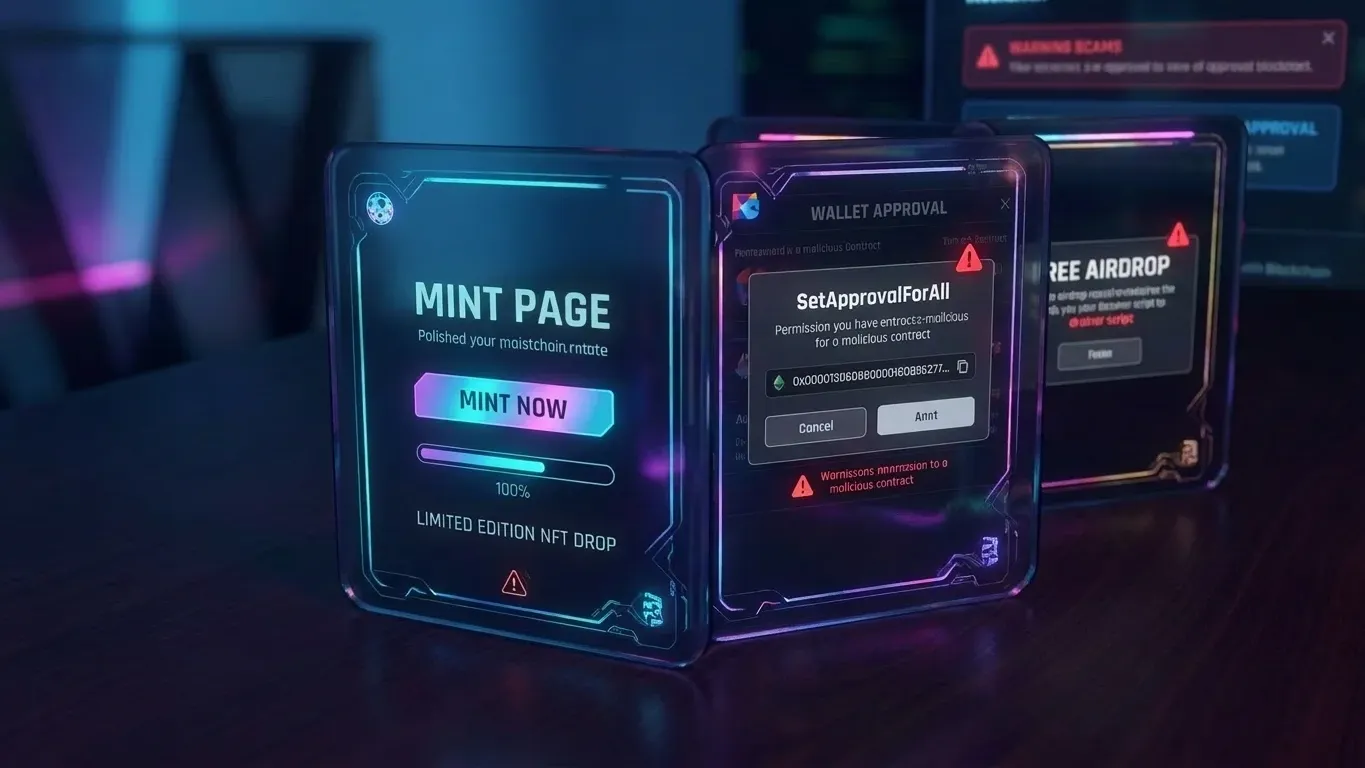
Action: read every transaction prompt. If it says setApprovalForAll or approve with an unfamiliar contract, reject it.
High
Marketplace impersonation and phishing
Fake marketplaces, fake support agents, and phishing emails capture seed phrases or trick users into signing malicious transactions. The OpenSea phishing attack of February 2022 lost users an estimated $1.7 million through this pattern.
Action: never enter a seed phrase into a website. Real support never asks for it. Bookmark official URLs and avoid clicking marketplace links from email or DMs.
High
Malicious airdrops and dust attacks
An unsolicited NFT lands in your wallet. Listing it, trying to sell it, or clicking through to "verify" it can trigger a hidden approval that drains the wallet.
Action: do not interact with NFTs you did not expect. Hide them in the wallet interface. Do not click any link the NFT contains.
Medium
Rug pulls and counterfeit collections
Loss is usually limited to the mint cost or purchase price. The wallet itself is not compromised, but the asset becomes worthless. Frosties (2022) and Evil Ape (2021) are the canonical examples, both prosecuted as wire fraud cases.
Action: verify the contract address against the project's official social channels before minting. Check that founders are doxxed or have verifiable track records.
Medium
Pump-and-dump and wash trading
You overpay for an asset whose price is artificially inflated. Loss is the difference between purchase price and real market value. Wallet stays intact.
Action: review the collection's trade history on a blockchain explorer. Repeated trades between the same wallets at increasing prices are the classic wash-trade signature.
Lower-risk if isolated
Social engineering on Discord and X
Fake support DMs, fake influencer giveaways, and surprise-mint announcements can lead to any of the patterns above. The vector is low-risk; the destination is usually not.
Action: close DMs on Discord servers. Verify any announcement across multiple official channels before clicking.
Framework: Blockready risk-literacy synthesis based on incident patterns at Revoke.cash, MetaMask, Phantom, and primary cases (OpenSea February 2022, Frosties 2022, Evil Ape 2021, Operation Atlantic April 2026).
The pattern in the matrix is clear: anything involving a signed approval belongs in the top tier. Anything involving a payment for an asset belongs in the middle. The distinction is whether the scam takes a one-time payment or installs a permanent vulnerability in your wallet.
The patterns up close: detection signals for each
The taxonomy and the risk matrix give you the shape. The detection signals tell you what to actually look at.
Counterfeit collections
OpenSea has publicly stated that more than 80% of items created using its shared storefront contract were plagiarized works, fake collections, or spam. The mechanism is simple: a scammer copies the artwork from a legitimate collection, mints it under a new contract address, and lists it on a marketplace where buyers may not look closely.
Detection signal: the contract address. Every legitimate project publishes its official contract address on its website, Discord, and verified social channels. Compare the address you see on the marketplace listing against the official address. They should match character-for-character. They never accidentally match a fake.
Rug pulls
Rug pulls split into two flavors. A hard rug pull is sudden: the team raises mint revenue, shuts down social channels, and disappears. The Frosties NFT case is the canonical 2022 example. The two founders, Ethan Nguyen and Andre Llacuna, raised approximately $1.3 million from buyers, then deleted the project's social presence overnight. They were indicted by the U.S. Attorney's Office for the Southern District of New York on conspiracy to commit wire fraud and money laundering charges in March 2022. A soft rug pull is slower: the team gradually reduces communication, founder wallets quietly dump their allocations, and the floor price erodes over months without a clear announcement.
Detection signals: anonymous teams with no verifiable track record, an unrealistic roadmap (promises of metaverse games, AAA partnerships, or "10x guaranteed"), founder wallets holding more than 20% of the supply, and aggressive social hype paired with weak product execution. Doxxed teams with prior work history are not a guarantee of safety, but anonymous teams with no history are a clear elevated risk. Many of these patterns overlap with broader investing mistakes we cover in our list of crypto mistakes to avoid.
Marketplace impersonation
Fake marketplaces clone the design of OpenSea, Magic Eden, Blur, or smaller chain-specific platforms. The URL is usually a near-miss (one extra character, a different top-level domain, a missing letter). When the user connects a wallet to "buy," the connection captures the wallet address and prompts an approval or signature that drains the assets.
Detection signal: the URL bar. Always. Bookmark the official URLs and use the bookmark, never search results, never an email link, never a Discord post link. Verified social accounts of legitimate projects can be hacked, so the URL discipline matters even when a "verified" account posts the link.
Malicious airdrops and dust attacks
A scammer sends an unsolicited NFT to your wallet. The image or metadata contains an instruction (a URL, a "claim your reward" prompt). When you visit the URL or attempt to list the NFT for sale, you sign a transaction that either drains the wallet directly or grants an approval that drains it later. MetaMask's security documentation documents this pattern in detail.
Detection signal: if an NFT arrived in your wallet that you did not buy, did not mint, and did not request, treat it as hostile. Do not click. Do not list. Do not try to "send it back." Hide it in your wallet interface and leave it dormant.
Pump-and-dump and wash trading
Coordinated buying groups push a collection's floor price up through repeated trades between insider wallets. Outside buyers see the price action, assume genuine demand, and buy in. The insiders then sell into the new liquidity and the floor collapses.
Detection signal: the trade history. On any blockchain explorer (Etherscan for Ethereum collections, equivalent tools for other chains), look at the recent transactions. If a small set of wallets are trading the same NFTs back and forth at progressively higher prices, you are looking at wash trading. A healthy collection shows distributed buyers and sellers.
The verification checklist: five steps before any NFT action
The reason the page-one guides leave you exposed is that they describe scams without giving you a procedure. The procedure is what protects you. Blockready's NFT safety framing puts the verification step before the engagement step, every time. Apply this checklist before every mint, every purchase, every wallet connection, and every signed transaction.
Pre-Action Verification Checklist
setApprovalForAll, approve with an unlimited amount, or a contract address you did not expect, reject and investigate.Framework: Blockready educational synthesis combining wallet-security guidance from MetaMask, Phantom, Revoke.cash, and the approval-mechanism research cited above.
This checklist is not exotic. It is also not optional if you plan to engage with NFTs regularly. Most of the catastrophic losses documented in the Revoke.cash exploit archive happened to users who skipped one of these steps, usually step three.
Common Misunderstanding
VPNs and antivirus software do not protect against NFT scams
Several top-ranking NFT scam guides recommend a VPN or antivirus subscription as protection. Those tools do not prevent you from signing a malicious approval. They do not catch fake mint pages that look legitimate. They do not detect a counterfeit contract address. The defense is behavioral and procedural: read transactions, verify addresses, audit approvals. Software cannot do that for you.
What to do if you have been scammed
Even careful people get caught. The speed of your response matters more than anything else after a compromise, because blockchain transactions are irreversible but approvals can be cut off before further losses.
Post-Compromise Response Scenarios
You just signed a suspicious transaction
Trigger: a wallet popup looked normal, you signed it, and now you suspect it was an approval you did not intend to give.
Path: open Revoke.cash or the Etherscan token approval checker. Connect the affected wallet. Identify the contract that received the approval. Revoke it.
Action: revoke immediately, then transfer any remaining valuable assets to a separate wallet that has never interacted with the malicious contract.
Note: revoking blocks future transfers. It cannot recover anything already taken.
An unknown NFT appeared in your wallet
Trigger: you opened your wallet and a collectible you did not buy or mint is sitting there, often with a name like "FREE-CLAIM" or "VISIT-URL".
Path: do not interact with it. Do not click it. Do not try to list it for sale. Most wallet interfaces have a "hide" or "spam" function.
Action: hide the NFT. Leave it dormant. The asset itself is harmless as long as you do not engage with it.
Note: trying to "burn" or transfer a malicious airdrop is often how the trap actually triggers.
You shared your seed phrase
Trigger: someone (a fake support agent, a fake security alert) convinced you to enter your seed phrase into a website or chat.
Path: the wallet is permanently compromised. Anyone with the seed phrase has full control. There is no revoke option that helps here.
Action: create a brand-new wallet on a different device. Transfer every asset that has not already been stolen to the new wallet immediately. Stop using the old wallet entirely.
Note: report the incident to the platform involved and to the FBI's IC3 (in the US) or your local cybercrime authority. Recovery is rare but documentation matters.
Framework: Blockready educational synthesis based on incident-response guidance from MetaMask, Phantom, and Revoke.cash.
None of these responses will reverse a transfer that has already happened. Crypto is irreversible by design, which is the same property that makes it useful for ownership records and unforgiving when something goes wrong. The point of fast action after a compromise is to stop additional losses, not to recover the original ones.
How to actually get safer over time
Most NFT losses happen because the person owning the wallet did not understand what they were signing. The fix is not a longer checklist or a stronger antivirus. It is a clearer mental model of how wallets, smart contracts, and token approvals actually work. With those primitives understood, most scams stop looking subtle and start looking obvious.
The order of learning matters. Wallets first, because every NFT lives behind a wallet's private keys. Smart contracts second, because every NFT scam exploits how contracts request permissions. NFT mechanics third, because the asset class only makes sense once the layers underneath are clear. Our explainer on what a crypto wallet actually is covers the first piece. Module 12 of Blockready's structured curriculum covers the NFT layer after the wallet and smart contract prerequisites are in place. If you are tracking adjacent scam patterns across the broader crypto space, our 2026 guide to crypto scams covers the wider taxonomy beyond NFTs specifically.
Our View
In our experience teaching crypto literacy, the most consistent reason beginners get caught by NFT scams is that they engage with NFTs before they understand wallets and smart contracts. Most listicle guides reinforce this by treating NFT safety as a list of red flags rather than a layer of understanding. We do not recommend any specific marketplace, wallet, or "safety tool" as a solution, because the solution is structural: read what you sign, verify before you click, and learn the primitives before you trade them. Scam guides that recommend a VPN, antivirus, or a paid "wallet scanner" are usually selling the wrong fix for the actual problem.
Frequently Asked Questions
What are the most common types of NFT scams?
The most common types are counterfeit collections, approval exploits, fake mint sites, marketplace impersonation, rug pulls, malicious airdrops, social engineering attacks, and pump-and-dump schemes. Approval exploits cause the largest individual losses because a single signed approval can grant a scammer permanent permission to move every NFT in a collection or unlimited spending on a token.
How do I verify an NFT before buying?
Verify the contract address against the project's official website, typed directly into the browser or opened from a bookmark, not from a search result or a social media link. Check that the team is identifiable or has a verifiable track record. Read the transaction prompt in your wallet before signing. If it asks for setApprovalForAll on an unfamiliar contract, reject it.
What is an NFT rug pull and how does it work?
A rug pull is a scam where the founders of an NFT project raise mint revenue from buyers, then abandon the project. A hard rug pull is sudden: the team disappears overnight. A soft rug pull is gradual: founder wallets quietly dump their allocations and the floor price erodes. The Frosties case (2022) is the canonical example, and the two founders were indicted on conspiracy to commit wire fraud and money laundering charges.
Can you get scammed by receiving an airdropped NFT?
Yes, but only if you interact with it. An unsolicited NFT sitting in your wallet is not dangerous by itself. The danger is when you click a link in the NFT, try to list it for sale, or attempt to transfer it. Any of those actions can trigger a hidden approval that drains your wallet. The safe response is to hide the NFT in your wallet interface and leave it alone.
What is approval phishing in crypto?
Approval phishing tricks a user into signing a transaction that grants a scammer permission to move tokens or NFTs from the user's wallet. It exploits the standard approve and setApprovalForAll functions in ERC-20 and ERC-721 token contracts. The scammer does not need the user's seed phrase or password. One signed approval is enough, and the approval stays active until manually revoked.
How do I revoke token approvals on my wallet?
Use Revoke.cash or the Etherscan token approval checker (or equivalent tools for non-Ethereum chains). Connect the wallet you want to audit, review the list of active approvals, and revoke any approval for contracts you no longer use, especially unlimited approvals. Revoking blocks future transfers but does not reverse anything that has already happened.
Are NFT marketplaces safe to use?
Established marketplaces like OpenSea, Magic Eden, and Blur are safe in the sense that the platforms themselves work as advertised. The risk is not the marketplace but the listings on it. OpenSea has publicly stated that more than 80% of items created with its shared storefront contract were plagiarized, fake, or spam. The marketplace is the venue; verifying each listing is still the user's responsibility.
What should I do if I have been scammed?
Move fast. Open Revoke.cash or a similar tool and revoke every approval granted to the malicious contract. Transfer remaining valuable assets to a fresh wallet that never touched the contract. If you shared your seed phrase, the wallet is permanently compromised and you must abandon it entirely after moving any remaining assets. Report the incident to the platform involved and to your local cybercrime authority. Recovery of stolen funds is rare, but documentation helps with investigations.
NFT Scam Defense Starts With the Vocabulary
Approval phishing, setApprovalForAll, wash trading, dust attacks, link rot. NFT safety leans on terms most beginner guides never define. Blockready's crypto glossary gives you clear, jargon-free definitions for the terms you need to recognize before you sign anything. Bookmark it and use it whenever a transaction prompt or scam guide starts speaking in acronyms.
