
Crypto Jargon, a Serious Guide: The Terms You Actually Need to Know
Most crypto guides give you a dictionary. This one gives you a framework for understanding the language, spotting manipulation, and knowing which terms actually affect your money.
Key Takeaways
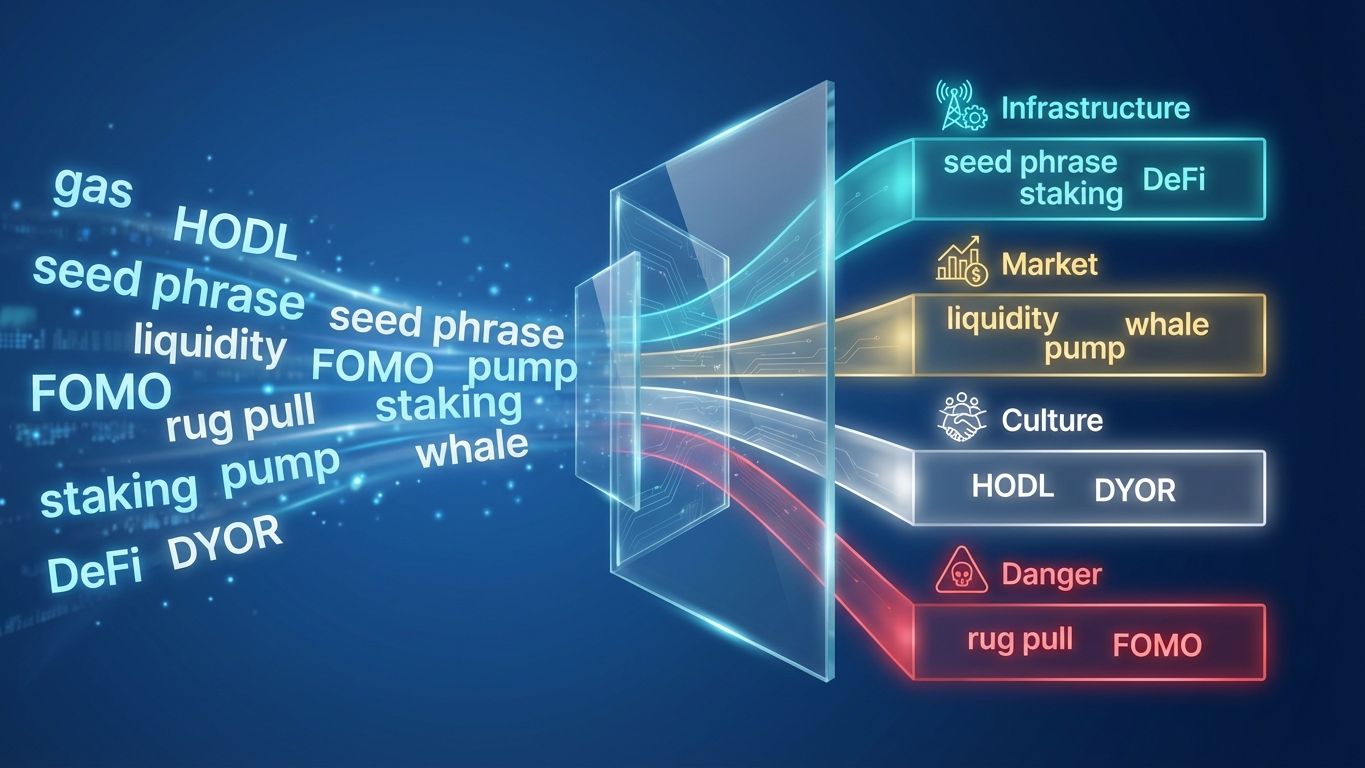
- Crypto jargon falls into four categories: infrastructure terms, market terms, community culture, and danger signals. Understanding the categories matters more than memorizing individual words.
- Some terms directly affect your money and security (private keys, gas fees, liquidity). Others are social shorthand you can pick up over time.
- Jargon is sometimes used deliberately to confuse, pressure, or manipulate. Recognizing this is one of the most practical forms of risk management in crypto.
- You do not need to memorize hundreds of terms. Roughly 40 to 50 core terms cover the vast majority of real conversations, news articles, and project announcements.
- A framework for categorizing new terms will serve you longer than any glossary, because the language evolves every year.
Why Crypto Has Its Own Language
Every industry develops specialized vocabulary. Medicine, law, finance, software engineering. Crypto is no different, except that it happened faster, more publicly, and with a much louder internet culture layered on top.
The result is a language that blends three very different things: genuine technical concepts that describe how blockchains work, market terminology borrowed from traditional finance, and community slang that emerged from forums, Reddit threads, and Twitter. When someone says "I'm HODLing my ETH through the dip while watching whale wallets for FUD signals," they are mixing all three in a single sentence. That sentence is completely normal in crypto spaces. It is also completely opaque to anyone who hasn't learned the vocabulary.
This matters beyond social comfort. Crypto jargon confusion isn't just awkward. It is expensive. People who do not understand terms like "seed phrase," "gas," or "liquidity" make avoidable mistakes with real money. People who cannot recognize manipulative language patterns (like "guaranteed returns" or "this is not financial advice" followed immediately by financial advice) walk into scams. The language barrier is not just an inconvenience. It is a risk factor.
Rather than listing hundreds of terms alphabetically, this guide organizes crypto jargon into four functional categories. Once you understand the categories, you can slot any new term you encounter into the right mental bucket, even if you have never seen it before. For a comprehensive term-by-term reference, Blockready maintains a full crypto and blockchain glossary with hundreds of definitions.
THE FOUR CATEGORIES OF CRYPTO JARGON
Category 1: Infrastructure Terms (The Ones That Affect Your Money)
These are the terms that describe how crypto actually works at a technical level. Getting them wrong is not a social faux pas. It can mean lost funds, failed transactions, or security mistakes.
The Essentials
Blockchain is the underlying technology: a distributed ledger that records transactions across a network of computers. No single entity controls it. Once data is recorded, it is extremely difficult to alter. Think of it as a shared spreadsheet that thousands of computers verify simultaneously.
Wallet is your interface for holding and transacting with crypto. "Hot wallets" are connected to the internet (convenient, more vulnerable). "Cold wallets" are offline devices (less convenient, more secure). The critical thing to understand: your wallet does not actually "hold" your crypto. It holds the private keys that prove you own the crypto recorded on the blockchain.
Private key and seed phrase are your access credentials. A private key is the cryptographic code that authorizes transactions from your wallet. A seed phrase (usually 12 or 24 words) can regenerate all your private keys. If someone obtains either of these, they control your funds. There is no password reset. There is no customer support. This is why the crypto saying "not your keys, not your crypto" exists, and it is not just slang. It is a foundational security principle.
Gas refers to the fee paid to process transactions on a blockchain. On Ethereum, every action (sending tokens, interacting with a smart contract) requires gas. Gas prices fluctuate with network demand. During periods of heavy activity, gas fees can spike dramatically, making simple transactions expensive.
Slightly More Advanced
Smart contract is self-executing code on a blockchain that runs automatically when conditions are met. DeFi, NFTs, and most crypto applications are built on smart contracts. Layer 1 refers to the base blockchain itself (Bitcoin, Ethereum, Solana). Layer 2 refers to systems built on top of a Layer 1 to handle transactions faster and cheaper (like Arbitrum or Optimism on Ethereum). Consensus mechanism is the method a network uses to agree on which transactions are valid. The two most common are Proof of Work (energy-intensive computation, used by Bitcoin) and Proof of Stake (validators lock up tokens as collateral, used by Ethereum since 2022).
Category 2: Market and Trading Terms
Most of these terms are borrowed from traditional finance but adapted for crypto's specific mechanics and volatility. If you have any background in stock markets or investing, you will recognize several of them, though the crypto versions often carry extra nuance.
Bull market and bear market describe the overall direction. A bull market means prices are generally rising and sentiment is positive. A bear market means prolonged decline and negative sentiment. "Bullish" and "bearish" are used as adjectives for individual opinions or signals. Someone might say they are "bullish on Ethereum" meaning they expect its price to increase.
ATH (all-time high) and ATL (all-time low) mark the extremes. When Bitcoin hit roughly $109,000 in January 2025, that was a new ATH. These benchmarks matter because they anchor psychology. People tend to buy near ATHs (driven by excitement) and sell near ATLs (driven by fear), which is usually the opposite of what would serve them well.
Market cap is the total value of a cryptocurrency, calculated by multiplying its price by the number of coins in circulation. It is useful for comparing relative size, though it does not capture the full picture of an asset's value or utility. Liquidity describes how easily an asset can be bought or sold without significantly moving its price. High liquidity means smooth trades. Low liquidity means large orders can cause wild price swings.
HODL technically belongs in the culture category (it originated from a 2013 Bitcoin forum typo), but it describes a real strategy: holding assets long-term through volatility rather than trying to time trades. DCA (dollar-cost averaging) is a related approach where you invest a fixed amount at regular intervals regardless of price, which reduces the impact of volatility over time.
Staking means locking up crypto to help validate transactions on a Proof of Stake network, earning rewards in return. DeFi (decentralized finance) is the ecosystem of financial applications built on blockchains, offering lending, borrowing, and trading without traditional intermediaries. Yield is the return earned from staking, lending, or providing liquidity in DeFi protocols.
Category 3: Community and Culture Terms
This is the layer that makes crypto conversations feel like a foreign language. These terms are social shorthand. They are useful for following discussions but rarely affect your actual investment decisions.
FOMO (fear of missing out) describes the impulse to buy when prices are rising fast. It is one of the most common drivers of bad timing in crypto. FUD (fear, uncertainty, and doubt) refers to negative information, whether true or exaggerated, that tanks market sentiment. Sometimes FUD is legitimate concern. Sometimes it is deliberate manipulation. Learning to tell the difference is a skill.
DYOR (do your own research) is the community's universal disclaimer. It sounds like good advice, and it is, but it is also frequently used by influencers to avoid accountability for the opinions they just shared. WAGMI ("we're all gonna make it") expresses collective optimism. NGMI ("not gonna make it") is its mocking opposite, usually directed at people making decisions the community considers foolish.
Whale is someone who holds a massive amount of a cryptocurrency, enough to move the market with a single trade. Tracking whale wallet activity is a legitimate analysis strategy. Degen (short for "degenerate") describes high-risk, low-research traders. Within the community, it is used both as an insult and a badge of honor, depending on context. Ape or "aping in" means buying aggressively into a project without thorough research, usually driven by hype or FOMO.
GM ("good morning") is a daily greeting on Crypto Twitter. CT refers to Crypto Twitter itself. Maxi (short for maximalist) describes someone who believes one particular cryptocurrency is superior to all others. A "Bitcoin maxi" believes Bitcoin is the only crypto worth holding.
Category 4: Danger and Scam Signals
This is arguably the most important category. These terms do not just describe concepts. They describe threats. Recognizing them in real time can protect your money.
Rug pull is a scam where developers create a project, attract investment, and then abruptly drain the funds and disappear. It is especially common with new tokens on decentralized exchanges where listings require no vetting. A related concept is the pump and dump, where a group artificially inflates a token's price through coordinated buying and hype, then sells at the top, leaving later buyers holding worthless assets.
Shill means aggressively promoting a cryptocurrency, often with undisclosed financial incentive. When someone "shills" a token, they may genuinely believe in it, or they may be paid to promote it, or they may hold a large position and want more buyers to push the price up. The term is inherently suspicious. If you hear it applied to someone's behavior, treat their recommendations with extra skepticism.
Honeypot is a smart contract scam where you can buy a token but the contract prevents you from selling. The price appears to rise (because only buying is possible), attracting more victims. Vaporware describes projects that exist only as marketing material and promises, with no working product behind them.
Red-Flag Language Patterns
Beyond specific scam terms, watch for broader language patterns that signal risk. Phrases like "guaranteed returns," "risk-free yield," or "this project cannot fail" violate basic financial reality. No legitimate investment guarantees returns. Pressure language like "last chance to buy," "the window is closing," or "you will regret not buying now" is designed to trigger FOMO and override careful thinking. Projects that describe themselves with relentless superlatives ("revolutionary," "game-changing," "the next Bitcoin") without explaining their actual mechanisms are usually compensating for a weak product with strong marketing.
The Real Risk
The biggest danger in crypto jargon is not failing to understand a word. It is failing to recognize when language is being used against you. Scams rarely announce themselves. They hide behind legitimate-sounding terminology, community enthusiasm, and urgency. A framework for spotting manipulative language is worth more than any glossary.
Putting It Together: Decoding a Real Crypto Message
To see how the four categories work together in practice, consider a sentence you might encounter on Crypto Twitter or in a Discord channel. It is the kind of message that looks routine to insiders but is packed with signals worth decoding:
"Whales are accumulating $TOKEN before the airdrop. Don't be ngmi. NFA but this is a 100x gem. DYOR."
Decoded: Large holders ("whales") are buying a specific token before it distributes free tokens to holders ("airdrop"). The writer is implying you will miss out ("ngmi") if you don't buy. They add "not financial advice" ("NFA") as a legal disclaimer while simultaneously calling it a high-return opportunity ("100x gem"). The final "DYOR" is the standard disclaimer.
Now apply the framework. The infrastructure terms (airdrop, token) are neutral. The market terms (accumulating, 100x) are speculative. The culture terms (ngmi, DYOR, NFA) are social signals. But the overall message is a shill using FOMO pressure tactics ("don't be ngmi"), a specific profit projection with no evidence ("100x gem"), and disclaimers designed to avoid responsibility, not to actually protect you. This is the kind of message where Category 4 awareness pays off.
What Matters Most
You do not need to memorize every term in a crypto glossary before you start learning. The terms that matter most are the ones in Category 1 (infrastructure) because they have direct consequences for your funds and security. Category 4 (danger signals) comes next because it protects you from losses. Categories 2 and 3 will develop naturally as you spend time in the space.
The framework itself is more durable than any word list. New terms appear every cycle. "Restaking," "liquid staking," "real-world assets (RWA)," "account abstraction," and "airdrop farming" are all relatively recent additions to the crypto vocabulary. Five years from now, there will be new ones. If you understand the four categories, you can file any new term where it belongs and immediately know whether it affects your money, describes market behavior, reflects community culture, or signals potential risk.
Structured learning is what turns scattered jargon into connected understanding. When you know how staking works at a mechanical level, terms like "validator," "slashing," "delegation," and "liquid staking" stop being separate vocabulary items and become parts of a single system you understand. That is the difference between memorizing definitions and actually understanding the space.
Not Sure Where to Start?
Take Blockready's free assessment to find out where you stand and get a personalized learning path across 13 modules of structured crypto education. From blockchain fundamentals to market mechanics, built for clarity.
Find Your Starting Point