
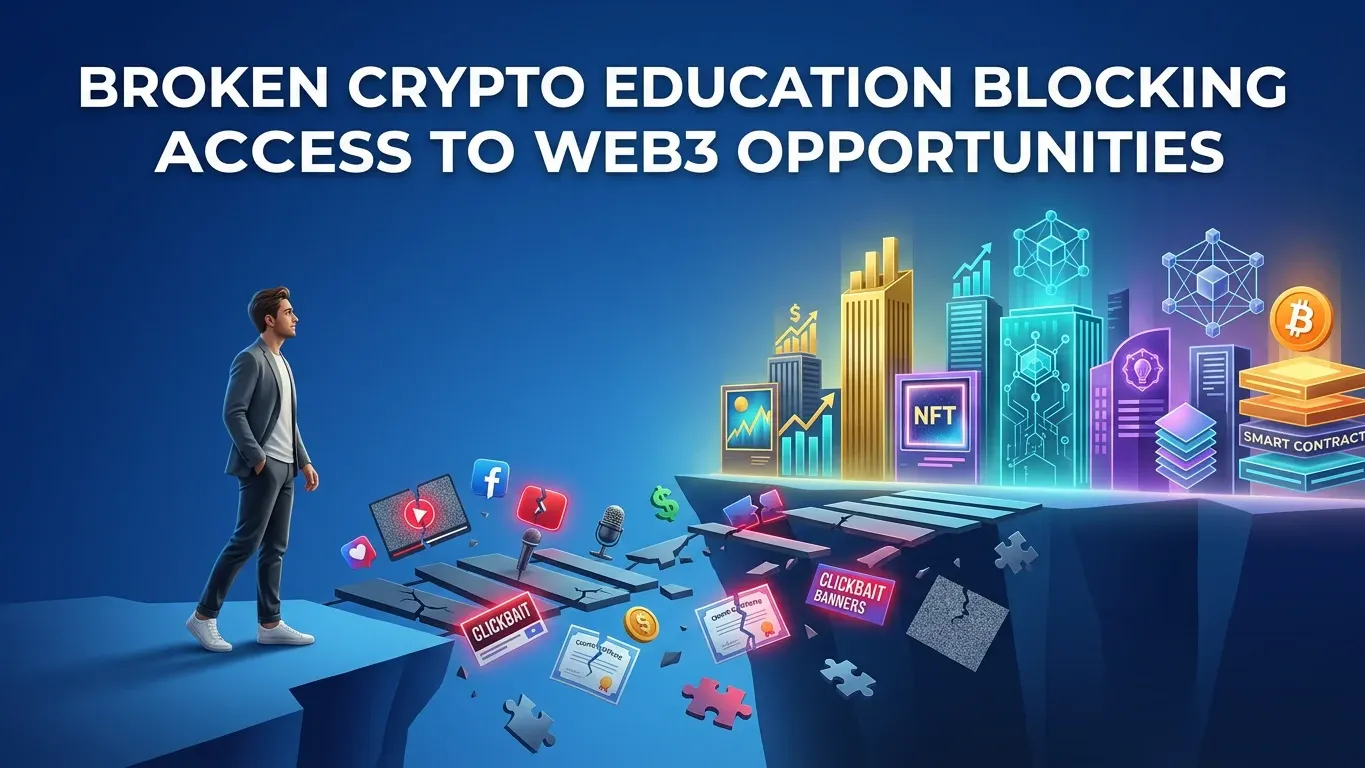
Crypto Education Is Broken. Here's What It's Actually Costing All of Us...
The Web3 economy offers real opportunities across careers, investing, business, and creative work. Most people never reach them because the education designed to get them there is built to sell, not teach.
Key Takeaways
- The Web3 economy spans careers, investing, business applications, and the creator economy, but most people never access these opportunities because the crypto education pipeline is structurally broken.
- Five dominant business models in crypto education are each optimized for the educator's revenue rather than the learner's outcome: influencer promotions, exchange academies, learn-to-earn programs, signal-selling groups, and outdated courses.
- The real cost of broken education goes beyond bad trades. It includes careers never pursued, business applications never explored, creative opportunities never realized, and a generation entering the digital economy without Web3 literacy.
- A leaked rate sheet exposed over 200 crypto influencers accepting undisclosed payments, with more than 95% of promotional content unmarked as sponsored.
- Five questions can help you distinguish genuine crypto education from marketing: follow the funding, check the independence, verify the freshness, look for structure, and ask who's accountable.
The Opportunity Most People Never Reach
Crypto education is broken at a structural level, with the dominant business models in the space optimized for revenue generation rather than learning outcomes, leaving most people unable to access the real career, investment, and business opportunities the Web3 economy offers. At Blockready, this problem is the reason the platform exists. Every design decision in the 13-module curriculum, from the subscription funding model to the CPD accreditation to the monthly content updates, was built as a direct response to the five broken models described in this post.
There is a version of the crypto conversation that rarely gets enough attention. Not the price speculation. Not the meme coins. Not the latest exchange drama. The version where blockchain technology is creating real, measurable opportunities for real people.
Developers and product managers are building careers in a Web3 job market that didn't exist a decade ago. Investors are learning to evaluate digital assets using the same analytical rigor they'd apply to any other asset class. Business owners are exploring how blockchain can improve supply chain transparency, payment infrastructure, and customer engagement. Artists and creators are using NFTs and token-gated content to build direct relationships with their audiences, bypassing traditional gatekeepers entirely.
The Web3 economy is not a future promise. It exists now, and it is growing. But the education pipeline that should connect curious, motivated people to these opportunities is failing them at scale.
Not because the information doesn't exist. There has never been more crypto content available. YouTube alone surfaces millions of results for "how to learn crypto." Twitter, Discord, Telegram, Reddit, podcasts, newsletters, free courses, paid courses. The volume is staggering.
The problem is that most of this content was not built to educate you. It was built to monetize you. And the difference between those two things is the difference between reaching the opportunities that Web3 offers and getting stuck in a cycle of confusion, bad decisions, and eventually walking away.
Five Business Models That Broke Crypto Education
Crypto education isn't broken because educators are lazy or uninformed. It is broken because the dominant business models create incentive structures that point away from the learner's success. Each model has its own specific problem, and understanding these mechanics is the first step toward finding sources you can actually trust.
1. Influencer-Driven "Education"
This is the most visible and arguably most damaging model. Crypto influencers build audiences on YouTube, X (formerly Twitter), TikTok, and Telegram by creating content that looks educational but often functions as paid promotion.
The mechanics work like this: a token project or exchange pays an influencer to create content featuring their product. The influencer frames it as analysis, a tutorial, or a review. The audience watches, trusts the recommendation because it came wrapped in educational packaging, and makes decisions based on what they believe is independent analysis.
In September 2025, on-chain investigator ZachXBT published a leaked rate sheet listing over 200 crypto influencers and their fees for promotional posts. The most striking finding wasn't the prices (though some charged five figures for a single post). It was the disclosure rate. According to the analysis, more than 95% of promotional content was not marked as paid, violating advertising guidelines under regulators like the FTC and ASA.
South Korea responded in February 2026 with proposed legislation requiring crypto influencers to disclose their complete asset holdings and all payments received for sponsored content. The fact that a national government felt the need to legislate this tells you how normalized the problem has become.
The damage isn't just financial. When people learn about crypto primarily through influencer content, they absorb frameworks shaped by whoever paid for the content. They learn which projects to pay attention to (the ones that can afford influencer budgets) and which to ignore (often the ones that can't). Their entire understanding of the space gets shaped by marketing spend, not by educational merit.
2. Exchange Learning Centers
Major exchanges like Binance and Coinbase have built extensive educational platforms. Binance Academy offers hundreds of articles and courses. Coinbase Learn rewards users with small amounts of cryptocurrency for completing short educational modules.
This content is often well-produced and technically accurate. The problem is structural: the curriculum exists to serve the exchange's business objectives. The learning path typically starts with "what is blockchain" and ends at "how to trade on our platform." Topics that might lead users to competitors, to self-custody solutions, or to conclusions like "I should wait before trading" are either absent or underemphasized.
The exchange academy model reinforces this pattern: it educates users just enough to become customers, not enough to become genuinely informed participants.
3. Learn-to-Earn Programs
Learn-to-earn sounds like a perfect idea. Watch a short video about a cryptocurrency project, answer a quiz, and receive a small amount of that project's token as a reward. Programs like Coinbase Earn have distributed millions of dollars in tokens this way.
But look at the incentive structure. The projects being featured are paying the exchange to be included in the learn-to-earn program. The "educational" content is written or approved by the project itself. The reward is denominated in the project's token, giving the learner a financial stake in the asset they just "learned" about. And the entire experience takes five to ten minutes, which is enough time to introduce a name and a basic concept but nowhere near enough to build genuine understanding.
Learn-to-earn conflates promotion with education. The learner walks away believing they've been educated, when what actually happened was a marketing campaign dressed in the language of learning. They now hold a token, feel some familiarity with the project, and have a psychological bias toward it, without the depth of understanding needed to evaluate whether it's worth holding.
4. Signal Groups and Guru Economics
Paid signal groups and trading "masterclasses" represent the most directly harmful model. The structure is straightforward: a self-described expert builds an audience through free content showing winning trades (often cherry-picked or fabricated), then funnels followers into paid groups where they receive trade alerts, entry/exit points, and market predictions.
The fundamental problem is that this model sells dependency, not skill. Followers never learn to analyze markets independently because the entire value proposition is "follow my signals." When the guru makes bad calls (and they always eventually do), or simply disappears, the follower has nothing. No frameworks, no analytical skills, no ability to evaluate opportunities on their own.
This model is particularly corrosive because it replaces education entirely. Someone paying $200 per month for a signal group genuinely believes they're investing in their crypto education. They're not. They're renting someone else's judgment, and the rental agreement has no quality guarantees.
FIVE BUSINESS MODELS THAT BROKE CRYPTO EDUCATION
Analysis: Blockready, 2026. Based on competitive landscape research across 30+ crypto education platforms and content sources.
5. Set-and-Forget Courses
The final model is the least dramatic but arguably the most widespread. Thousands of crypto courses exist on platforms like Udemy, Skillshare, and independent creator sites. Many were built during the 2021 bull market, and a significant number have not been meaningfully updated since.
Crypto moves fast. A course from 2021 might still reference DeFi Summer mechanics, pre-Merge Ethereum (which transitioned to proof-of-stake in September 2022), or protocols that no longer exist. It might describe a regulatory environment that has since been completely overhauled. A learner taking that course today has no way of knowing which information is still accurate and which is dangerously outdated, unless they already have enough knowledge to evaluate it. Which defeats the purpose of taking a course.
The business incentive is clear: building a course once and selling it indefinitely produces the highest margin. Updating content requires ongoing investment. The result is a market flooded with digital courses that look comprehensive in their marketing copy but deliver knowledge frozen in time.
The Real Cost: What Broken Education Locks People Out Of
THE COST OF BROKEN CRYPTO EDUCATION
Sources: FBI IC3, Chainalysis, ZachXBT
The most common way to frame the cost of bad crypto education is through scam statistics. And those numbers are real: the FBI's 2024 Internet Crime Report documented $9.3 billion in crypto-related losses, a 66% increase over the previous year. Chainalysis estimated that crypto scams received at least $14 billion on-chain in 2025 alone.
But focusing only on scam losses misses the larger picture. The true cost of broken crypto education is measured in opportunities that never materialize.
Think about the professional in finance or consulting who hears that blockchain will reshape their industry, tries to self-educate through scattered YouTube videos, encounters contradictory information and thinly veiled marketing, and concludes that "crypto is just hype." That person doesn't get scammed. They simply never develop the Web3 literacy that their career increasingly demands. The cost is invisible but real: a competency gap that widens every year.
Or the business owner exploring whether blockchain could improve their supply chain transparency or customer engagement. They search for educational resources, find exchange academies that teach them how to trade but nothing about enterprise applications, and drop the investigation. The cost isn't a financial loss. It is a competitive advantage they never explored.
The pattern repeats across every segment. The artist who hears about NFTs during the 2021 hype, absorbs wildly inflated expectations from outdated content, and dismisses the entire concept before learning the underlying mechanics. The student entering the workforce in 2026 whose formal education never covered Web3, who turns to the internet and gets marketing disguised as education. The cautious investor who wants to allocate to digital assets with the same analytical rigor they'd apply to stocks, who finds only influencer content optimized for engagement and courses frozen in 2021.
None of these people lost money to a scam. They lost something harder to quantify: access to an economy that is growing with or without them.
How to Tell If You're Being Educated or Marketed To
The good news is that genuine crypto education does exist. The challenge is distinguishing it from the marketing that dominates the landscape. Five questions can help.
IS THIS EDUCATION OR MARKETING? A 5-QUESTION TEST
Framework: Blockready Education Evaluation Criteria
These aren't unreasonable questions. They are the same criteria you'd apply to any professional education in any other field. The fact that they disqualify most crypto education tells you everything about how the current market is structured.
The Bigger Picture
The crypto education market isn't broken because crypto is too complex to teach well. It is broken because the dominant business models are optimized for the educator's revenue, not the learner's outcome. Fixing this isn't just about protecting people from scams. It is about ensuring that the Web3 economy's real opportunities, in careers, in investing, in business, in creative work, are accessible to everyone willing to learn, not just those lucky enough to find a trustworthy source.
What Genuine Crypto Education Actually Requires
If the five broken models share one common failure, it is that they treat education as a byproduct of some other business goal. Genuine crypto education, the kind that actually prepares people to participate in the Web3 economy, requires something different.
It requires structured progression: a logical path from foundational concepts to practical application, where each topic builds on what came before. Not a collection of standalone videos designed for algorithmic discovery, but an actual curriculum. Blockready's 13-module structure was designed around this principle: you cannot meaningfully understand DeFi (Module 11) without first understanding smart contracts (Module 3) and token economics (Module 4). That dependency chain is what makes a curriculum different from a content library.
It requires independence from product promotion. The moment a curriculum is funded by the projects it teaches about, the content is compromised. The funding model has to come from the learner, not from the things being taught.
It requires ongoing updates. Crypto changes too fast for static content. Any serious educational program needs a review cycle that catches regulatory shifts, protocol changes, and market developments before they make the content misleading. For a deeper comparison of how free and paid crypto courses handle this update problem, our analysis of the education landscape breaks down the tradeoffs.
It requires multiple learning formats. People learn differently, and complex topics benefit from being approached through different lenses: text, video, interactive tools, practical exercises, assessments. The format diversity isn't a luxury feature. It is how retention actually works.
And it requires accountability. Some form of external validation, whether that is third-party accreditation, published editorial standards, or transparent methodology, that holds the education provider to a standard beyond "people watched the videos."
These are not unreasonable criteria. They are the baseline for any professional education domain. The fact that they are rare in crypto education tells you everything about how the current market is structured.
The Web3 economy is growing. The career opportunities are real. The investment frameworks exist. The question isn't whether these opportunities will keep developing. It is whether the education pipeline will ever become reliable enough to connect motivated people to them. Right now, for most learners, the pipeline itself is the bottleneck.
Frequently Asked Questions
Not Sure Where Your Crypto Knowledge Stands?
Take Blockready's free assessment to find out where you are and get a personalized learning path across 13 modules of structured, independently funded crypto education. No hype. No hidden sponsors.
Find Your Starting Point