
Can AI Really Trade Crypto? A Reality Check on LLMs, Bots, and Backtesting
AI can trade crypto in the narrow sense of automating orders and speeding up research, but it cannot reliably predict prices or create a trading edge on its own. If you have spent weeks asking a chatbot for strategies and watching most of them fall apart the moment real costs and live markets enter the picture, this article was written for exactly that experience.
Key Takeaways
- AI can assist with research, coding, data analysis, and backtesting, but it does not create a durable trading edge by itself.
- A bot automates execution, not edge. It runs whatever logic you give it, good or bad, with equal discipline.
- A backtest is a filter, not proof. Overfitting, ignored fees, and changing market conditions make many impressive backtests fail live.
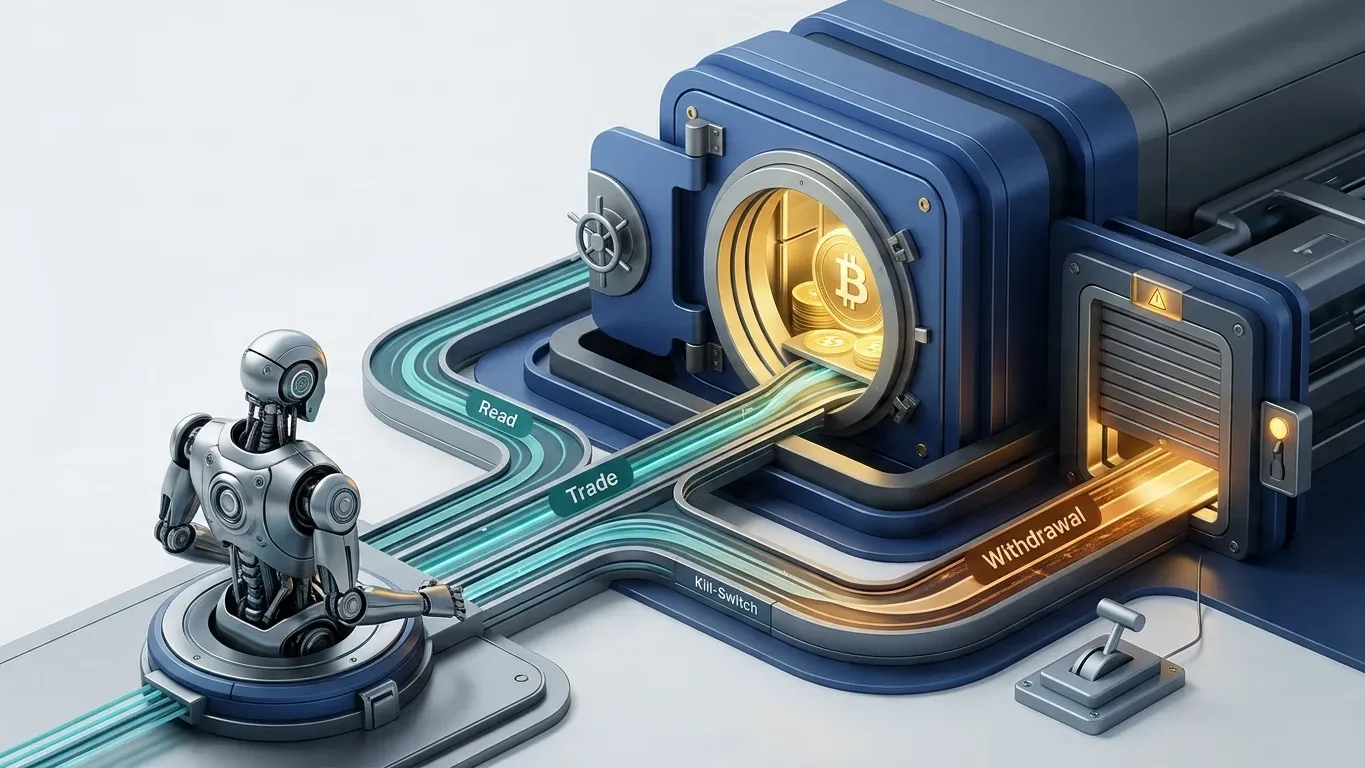
- The most underestimated risk is security: trading bots often request exchange API keys, and withdrawal permissions should almost always stay off.
- Regulators have warned that "guaranteed" AI return claims are a classic fraud pattern, not a sign of sophistication.
The story shows up in trading forums again and again. Someone spends months asking large language models for crypto strategies, generates hundreds of variations, backtests them late into the night, and keeps landing in the same place: a few curves that look beautiful in history and almost nothing that survives once fees, slippage, and live conditions are taken seriously. That experience is not proof that AI is useless. It is a useful warning. AI can make research faster, but it can also make false confidence cheaper.
At Blockready, we teach the mechanics behind a market before any tool that operates inside it, because that order is what protects beginners from expensive mistakes. This article is educational and is not financial advice, a trading signal, or a recommendation to use any bot, platform, or strategy. The goal is narrower and more useful: to help you separate what AI genuinely does well from the parts of trading it cannot solve for you.
The short answer: AI can help, but it does not create edge
AI can take over real parts of a trading workflow. It can explain an indicator, draft code, summarize a research paper, scan for patterns, send alerts, and place orders automatically through a connected bot. What it cannot do is know the future. The U.S. Commodity Futures Trading Commission put it plainly in its 2024 advisory on AI trading scams, warning that AI technology cannot predict the future or sudden market changes and that claims of high or guaranteed returns are a red flag of fraud.
Can AI trade crypto?
AI can help with parts of crypto trading, such as research, coding, data analysis, backtesting, alerts, and automated execution. But AI cannot reliably predict crypto prices or guarantee profits. A trading bot only executes the logic it is given, and an LLM can generate convincing ideas that still fail because of overfitting, fees, slippage, bad data, changing market conditions, or security risks.
Simple version: a bot automates execution, not edge. The hard parts of trading stay hard.
Hold onto that distinction, because almost every disappointment with AI trading traces back to it. The tools are good at producing and running ideas. They are not good at deciding whether an idea was ever worth running.
What people actually mean by "AI crypto trading"
The phrase gets used for at least four very different things, and mixing them up is where confusion starts. A signal provider, meanwhile, is a fifth category that sits on top of these: a person, group, or service that sends buy and sell suggestions, whose quality and incentives vary enormously and are often impossible to verify.
Four Things People Call "AI Crypto Trading"
Framework: Blockready educational synthesis based on the tool categories described in the sources cited in this article.
Notice that none of these four is magic. An LLM is a language tool. A rule-based bot is a discipline tool. A machine-learning system is a pattern tool with a shelf life. An autonomous agent is all of the above with the safety rails loosened. Reaching for a more autonomous tool does not make a weak idea stronger. It just removes the human check that might have caught the weakness.
What LLMs are genuinely useful for, and where they fail
Used as an assistant rather than an oracle, a large language model can save you real time. It can explain what crypto technical indicators can and cannot tell you, turn a messy idea into explicit rules, draft a non-executing backtest checklist, summarize your trading journal, and stress-test your assumptions by asking what could go wrong. None of that requires the model to be right about the market. It only requires the model to organize your thinking.
The failures cluster on the other side: anything that depends on the model knowing something true about live markets. LLMs do not reliably predict prices, they do not see live order books unless connected to data tools, and they cannot tell by intuition whether a strategy has real edge. They also state wrong things with total confidence. OpenAI's own research explains that language models tend to guess confidently when they are uncertain because common evaluations reward guessing over admitting doubt. A separate academic study of LLMs in finance documented serious hallucination on tasks as basic as explaining concepts and recalling historical prices (Kang and Liu, 2023). A fluent answer is not a verified one, and weak chart literacy is not something a chatbot can paper over, which is why it helps to know how to read crypto charts without pretending every pattern is a trade signal.
AI Trading Tools: What They Can and Cannot Do
Framework: Blockready educational synthesis based on the tool capabilities described in the sources cited in this article.
This is not academic. The downside of mistaking a fluent assistant for a profitable system shows up in the loss data. The FBI's 2025 Internet Crime Report, released in April 2026, recorded 181,565 cryptocurrency-related complaints with reported losses above $11 billion, and for the first time broke out artificial intelligence as its own category, with 22,364 complaints and nearly $893 million in reported losses (FBI, 2026). Complaint data is not the same as total global losses, but the direction is clear: AI is being attached to the same old promises, and people are paying for it.
What crypto trading bots actually automate
A trading bot is software that places orders according to rules. The common ones automate dollar-cost averaging, grid trading, portfolio rebalancing, arbitrage scanning, and signal execution, plus stop and limit workflows. That can be genuinely valuable. A bot does not get bored, does not panic at 3 a.m., and does not skip a rule because it had a bad day. A bot is discipline in software form. That is powerful if the rules are good, and dangerous if the rules are bad, because it will execute a losing idea just as faithfully as a winning one.
The trap is assuming that automation and intelligence are the same thing. They are not. A rule-based bot has no opinion about whether your strategy makes sense. It simply does what it is told, forever, until you stop it. So the real question was never "should I automate this?" It was "is the thing I am about to automate actually any good?" And that question lives almost entirely in the backtest.
Why backtesting can lie, and why a backtest is a filter not proof
A backtest is a simulation of how a strategy would have performed on historical data. It is a useful tool. It is also where most AI-generated strategies quietly fall apart, because a backtest can be made to look good in ways that have nothing to do with future profit. The classic failures are well documented: overfitting to noise, look-ahead bias, survivorship bias, perfect-fill assumptions, ignored funding rates, and quietly dropped fees and slippage. Small apparent edges often vanish the moment realistic trading costs are included.
AI makes this worse in a specific way. Because a model can generate hundreds of strategy variations in an afternoon, it becomes very easy to keep testing until one curve looks spectacular, then mistake that lucky curve for evidence. Researchers have formalized exactly this danger. Work on the probability of backtest overfitting shows how testing many configurations inflates the odds of selecting a strategy that succeeded by chance, and the related deflated Sharpe ratio adjusts performance metrics for that selection bias and for non-normal returns. A crypto-specific study of deep reinforcement learning trading reached a sober conclusion too: reliable strategies are hard in highly volatile markets, and optimistic backtests can be false positives driven by overfitting (Gort et al., 2022).
The honest way to use a backtest is to treat it as one filter in a sequence, not as a verdict. A more disciplined order looks like this: test in sample, then test on out-of-sample data the strategy has never seen, then run a walk-forward test that rolls the window forward through time, then paper trade in real conditions without real money, and only then consider a small, controlled live test if everything still holds. Most ideas die somewhere in that sequence, which is the point. Blockready's curriculum works through chart literacy, exchanges, wallets, risk, and market structure in sequence, including a dedicated trading module that covers indicators like RSI and MACD, leverage, and market psychology, so the concepts an AI tool throws around have somewhere solid to land.
Crypto adds its own hazards on top. Markets run 24 hours a day, altcoin order books can be thin enough that a single bot order moves the price, funding rates bleed leveraged positions, and exchanges occasionally go down at the worst possible moment. Leverage turns a modest move into a forced exit, and automation can scale that risk faster than a human would. It is worth understanding how liquidation cascades can turn small moves into forced selling before letting any bot trade with borrowed money.
The security risk most beginners underestimate: API keys
To trade for you, a bot usually needs an API key, which is a credential that lets one application act on your exchange account. Exchange API keys come with separate permissions, and this is where the real danger sits. Documentation from major exchanges describes the standard model clearly: keys can be scoped to read-only access, trading access, and withdrawal or transfer access, and the safe default is to grant only what is needed, as documented by Binance Academy, Kraken, and Coinbase Developer Docs.
Risk
Never give a trading bot withdrawal permissions
A connected bot needs permission to place trades. It almost never needs permission to move funds off the exchange. Grant read and trade access only, keep withdrawal and transfer permissions disabled, restrict the key to a specific IP address where the exchange supports it, and delete keys you no longer use. A key that cannot withdraw is a far smaller prize if the bot platform is ever breached or turns out to be malicious.
It is an honest mistake to assume that connecting a bot is a simple toggle, the same way most people set up any other app. The security model is different, and the gap usually only becomes obvious after something goes wrong. The same permissions thinking that protects a self-custody wallet applies here, which is why it helps to understand the fundamentals of crypto wallet and account security and how crypto exchanges work behind the scenes before handing any tool the keys to a funded account.
How AI trading scams usually sound
Many "AI trading" pitches are not failed strategies at all. They are old scams wearing new vocabulary. The structure is familiar from cloud-mining and high-yield schemes: a guaranteed return, a secret system, social proof, and friction the moment you try to take money out. AI just makes the packaging more convincing. The SEC, NASAA, and FINRA jointly warned in their AI and investment fraud investor alert that promoters have used AI claims such as "can't lose" and "guaranteed winners," and that high or guaranteed returns with little or no risk are classic warning signs of fraud.
AI Trading Scam Claims vs Reality
Claim
"Our AI bot delivers guaranteed daily profit."
Presented as proof of advanced technology.
Reality
No legitimate strategy can guarantee returns.
Regulators treat guaranteed or unusually high returns as a leading fraud signal, not a feature.
Claim
"The algorithm is secret, so you can't see inside it."
Framed as protecting a valuable edge.
Reality
A black box you cannot inspect is one you cannot validate.
If no one can explain or check the method, there is nothing to trust except the marketing.
Claim
"Pay a small fee to unlock your withdrawal."
Often arrives once your balance looks large.
Reality
Real platforms do not charge a fee to release your own funds.
This is a textbook advance-fee pattern, and the "balance" is usually fake.
Claim
"Here are screenshots and a celebrity endorsement."
Used to manufacture instant credibility.
Reality
Screenshots and videos are easy to fake.
AI now generates convincing fake profiles, voices, and clips, so only independently verifiable records count.
Framework: Blockready educational synthesis based on CFTC, SEC/Investor.gov, and FBI fraud-warning guidance cited in this article.
These patterns are not hypothetical. In December 2025 the SEC charged several purported crypto trading platforms and investment clubs in a scheme that allegedly recruited victims through social media ads, moved them into messaging-app groups where fraudsters posed as financial professionals, promised profits from "AI-generated" investment tips, and then misappropriated funds through fake platforms that falsely claimed government licenses (SEC, 2025). These are allegations in a pending case, but the playbook is the one to memorize: ad, group chat, AI credibility, fake platform, blocked withdrawal.
A checklist before trusting any AI crypto trading claim
You do not need to be a quant to evaluate an AI trading tool. You need a short list of honest questions and the discipline to walk away when the answers are vague. If a system, a signal group, or a salesperson cannot answer these, that is the answer.
AI Crypto Trading Reality Check
Framework: Blockready educational synthesis based on the backtesting, security, and fraud-warning sources cited in this article.
This is the same skeptical posture that protects beginners across every part of crypto, not just trading. The questions echo the most common crypto mistakes beginners make, and the habit of demanding evidence before trust is the heart of a structured framework for evaluating crypto projects. AI should support that due diligence, never replace it.
So, should beginners use AI to trade crypto?
It depends entirely on what "use AI" means. If it means learning faster, organizing your research, drafting non-executing code, and pressure-testing your assumptions, then yes, cautiously, AI is a good study partner. If it means trusting a black-box bot with real funds before you understand the strategy, usually no. And if it means expecting guaranteed profit from a tool that promises certainty, then no, that is the exact pattern regulators keep warning about.
Where we land
We do not recommend connecting any bot to a funded exchange account until you can explain its strategy, its costs, and its failure modes in plain English without leaning on the word "AI." Automation rewards a good process and punishes a weak one at the same speed, which is why Blockready teaches market mechanics and risk before any conversation about tools. Use AI to improve your questions, not to outsource your judgment.
Frequently Asked Questions
Can AI really trade crypto?
AI can automate parts of crypto trading, including research, coding, alerts, and order execution, but it cannot reliably predict prices or guarantee profits. A bot only runs the logic it is given, so the outcome still depends on whether that logic had a real edge after fees, slippage, and changing market conditions.
Can ChatGPT predict Bitcoin or crypto prices?
No. ChatGPT and similar tools cannot reliably predict crypto prices, and the CFTC has warned that AI cannot predict the future or sudden market changes. They can explain concepts and organize ideas, but they also state wrong things confidently, so any market claim from an LLM needs independent verification.
Are AI crypto trading bots profitable?
AI crypto trading bots are not automatically profitable. Results depend on the underlying strategy, market conditions, execution costs, exchange liquidity, risk controls, and whether the backtest was realistic. Be cautious of any bot that promises guaranteed returns or refuses to explain how it works.
What is the difference between an AI bot and a rule-based trading bot?
A rule-based bot follows fixed if-then rules and never adapts on its own. An "AI" bot usually implies a machine-learning model that adjusts to data, but the label is also a marketing term applied to ordinary bots. Either way, neither type guarantees an edge, and a rule-based bot you fully understand is often easier to evaluate than an opaque "AI" one.
Is it safe to connect a trading bot to my exchange account?
Only with strict limits. Give the bot read and trade permissions but keep withdrawal and transfer permissions disabled, restrict the API key to a specific IP address where possible, and delete keys you stop using. A key that cannot move funds off the exchange is far less damaging if the bot or platform is ever compromised.
Why do trading bots perform well in backtests but fail live?
Backtests are easy to overfit, and live trading adds costs and frictions the simulation ignored. Generating many strategies and keeping the best historical curve inflates the chance of selecting a lucky result, and fees, slippage, funding rates, and shifting market conditions then erode the apparent edge once real money is at stake.
What can I safely use an LLM for in crypto trading research?
Use it to explain indicators, summarize research, draft non-executing code or pseudocode for your own review, build a backtesting or risk checklist, and challenge your assumptions. Keep it as a study partner rather than a signal source, verify anything factual against primary data, and never let it place trades or set leverage on your behalf.
What is the first sign an AI crypto trading bot is probably a scam?
A promise of guaranteed or unusually high returns with little risk is the clearest early warning. Other strong signals include a secret algorithm no one can explain, pressure to deposit quickly or join a private chat group, screenshot-only proof, and any request to pay a fee before you can withdraw your own funds.
Go Deeper With Structure
Blockready's masterclass covers the foundations behind every AI trading question, from charts, exchanges, and wallets to risk, scams, and market structure, including a dedicated trading module. It is built for clarity, not hype, so you understand the market before you ever automate a decision inside it.
Explore the Full Course