What Smart Contracts Actually Are and How They Work
They're called "smart," but they don't think. Here's what they actually do, how they execute, and why that matters for anyone using crypto in 2026.
Key Takeaways
- A smart contract is a program stored on a blockchain that executes automatically when specific conditions are met, with no middleman required.
- "Smart" is misleading: these contracts are automatic and deterministic, not intelligent or adaptive. Once deployed, they run exactly as coded, including any bugs.
- Smart contract vulnerabilities caused over half of all crypto exploits in 2025, with the OWASP Smart Contract Security Project documenting roughly $905 million in losses across 122 incidents.
- Every time you swap tokens, lend crypto, or buy an NFT, you're interacting with a smart contract. Understanding what that means is practical, not theoretical.
- Smart contracts can't access real-world data on their own. They rely on external data feeds called oracles, and that dependency introduces its own risks.
The Simplest Explanation (and Why the Name Is Misleading)
A smart contract is a computer program that lives on a blockchain. It holds a set of rules. When those rules are satisfied, the program executes automatically. No person approves the transaction. No company processes it. The code runs, and the result is recorded permanently on the blockchain.
The most common analogy is a vending machine. You insert the correct amount of money, press a button, and the machine dispenses your item. No cashier. No negotiation. The machine follows its rules every single time. A smart contract works the same way, except instead of snacks, it handles digital assets, permissions, and agreements.
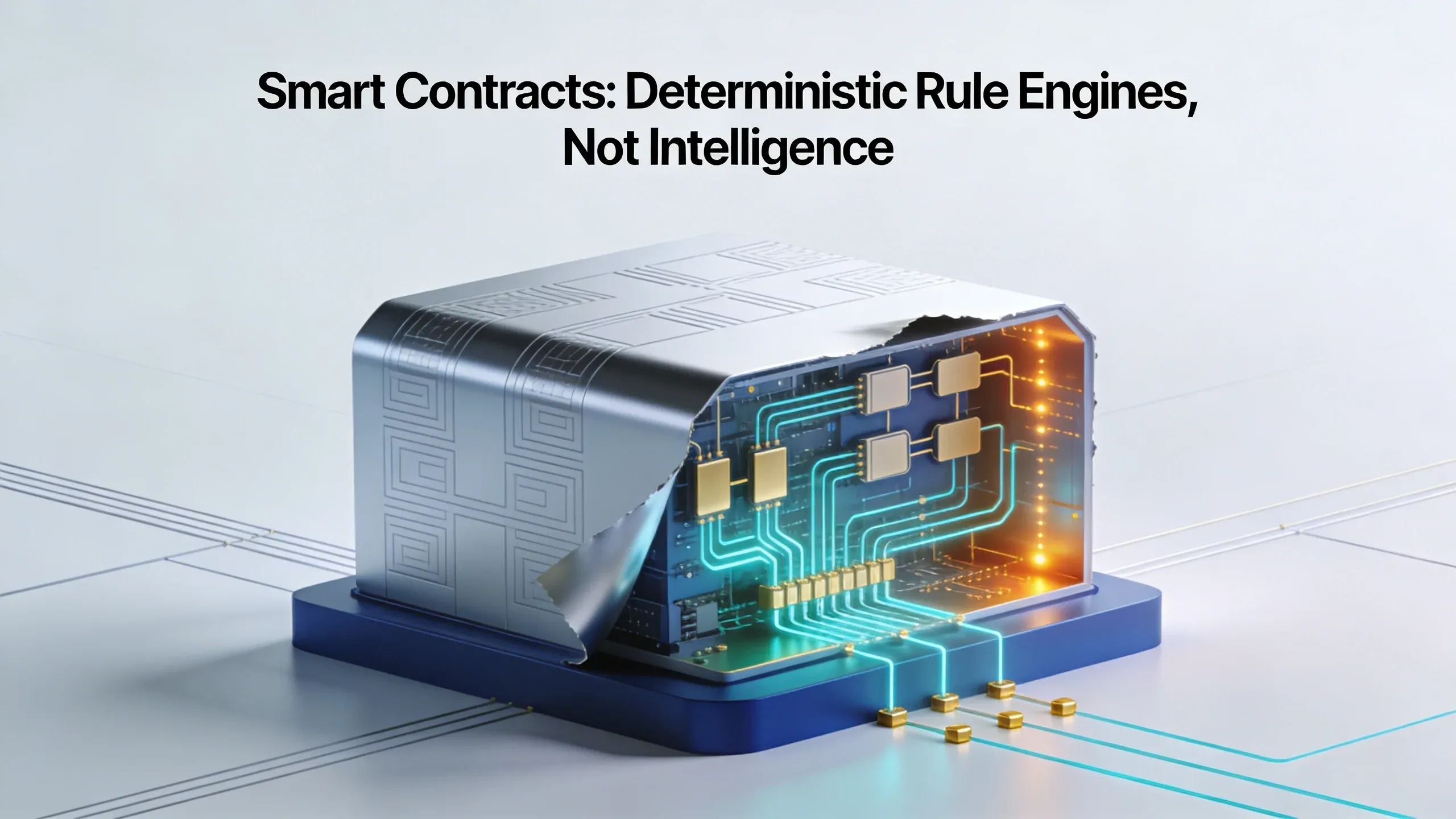
But here's what trips people up: the word "smart" suggests intelligence, adaptability, judgment. It has none of those. A smart contract is smart in the same way a toaster is smart. It follows the instructions it was given. If the instructions contain a mistake, it follows the mistake. It will never catch an error, flag something suspicious, or ask for a second opinion. This distinction matters more than it sounds, because it's the root of nearly every smart contract exploit in crypto history.
Where Smart Contracts Came From
The concept predates blockchain entirely. Computer scientist Nick Szabo coined the term in 1994, describing self-enforcing digital agreements that could reduce the need for trusted intermediaries. His vending machine example captured the core idea: a system where the rules are built into the mechanism itself, not enforced by a third party after the fact.
But Szabo's idea didn't have a home yet. The technology to run self-enforcing contracts on a decentralized network didn't exist. Bitcoin, launched in 2009, introduced blockchain to the world, but its scripting language was intentionally limited. Bitcoin can handle basic transactions ("send X amount to Y address"), but it can't run complex logic. It was designed as a payment system, not a programmable platform.
That limitation is exactly what Vitalik Buterin set out to solve. In 2013, he proposed Ethereum: a blockchain designed specifically to run smart contracts. When Ethereum launched in 2015, it introduced the Ethereum Virtual Machine (EVM), a decentralized computing environment shared across all nodes on the network. For the first time, developers could write arbitrary programs and deploy them on a public blockchain where anyone could interact with them.
Today, smart contracts run on many blockchains beyond Ethereum: BNB Chain, Polygon, Arbitrum, Avalanche, Solana (which uses a different architecture but achieves similar outcomes), and dozens more. But Ethereum remains the dominant smart contract platform, hosting over 60% of all DeFi activity by total value locked.
What Actually Happens When a Smart Contract Executes
This is where most explanations stop. They tell you smart contracts "run automatically" and move on. But if you're going to interact with smart contracts (and if you use any DeFi application, you already are), you need to understand the actual sequence of events. Let's walk through what happens when you execute a token swap on a decentralized exchange.
WHAT HAPPENS WHEN A SMART CONTRACT EXECUTES
Sources: Ethereum Foundation documentation, ethereum.org
The entire sequence happens in seconds. No human reviewed it. No company approved it. The contract checked its conditions, executed its logic, and recorded the result. Every node on the network independently ran the same code and arrived at the same answer. That's the core mechanism.
One practical detail that catches beginners off guard: gas fees. Every operation a smart contract performs costs computational resources, and someone has to pay for them. On Ethereum, that cost is denominated in ETH and fluctuates based on network demand. When the network is busy, gas fees spike. When it's quiet, they drop. A simple token swap might cost $2 on a slow day and $50 during a popular NFT mint. The price difference is real and worth planning around.
What Smart Contracts Power Today
Smart contracts aren't a theoretical concept waiting for adoption. They're the operational backbone of a financial ecosystem managing roughly $95 billion in total value locked as of early March 2026, according to DefiLlama data. Here's what they actually do.
Lending and borrowing
Protocols like Aave use smart contracts to run entire lending markets without a bank. Depositors supply tokens to a lending pool and earn interest automatically. Borrowers lock collateral (typically worth more than the loan) and withdraw other tokens. If a borrower's collateral value drops below a safety threshold, the smart contract automatically liquidates the position to protect lenders. There's no loan officer, no credit check, and no waiting period. Aave became the first DeFi protocol to process over $1 trillion in cumulative loans, a milestone it reached in early 2026.
Token swaps
When you swap tokens on a decentralized exchange like Uniswap, you're interacting directly with a smart contract. The contract uses a mathematical formula called an Automated Market Maker (AMM) to calculate exchange rates based on the ratio of tokens in a liquidity pool. No order book. No matching engine run by a company. The math in the contract determines the price.
NFT ownership
Every NFT is a smart contract. When you buy one, the contract transfers ownership from the seller's wallet to yours in a single transaction. Some NFT contracts also enforce creator royalties, automatically sending a percentage of every resale back to the original artist. The enforcement happens in code, not through a legal agreement that someone might choose to ignore.
These three examples share a pattern: the smart contract replaces a function that traditionally required a trusted intermediary (a bank, an exchange, a registrar) with code that executes the same function automatically. That's the value proposition. But it comes with a tradeoff that deserves equal attention.
What Can Go Wrong
Smart contracts are transparent and auditable. They're also not bug-free. And because they're immutable (once deployed, the code can't be changed), a bug in a smart contract isn't like a bug in a banking app. You can't issue a patch overnight. The options are: deploy an entirely new contract and convince everyone to migrate to it, or accept the consequences.
The numbers are sobering. OWASP's 2026 report analyzed 122 smart contract incidents in 2025 and documented roughly $905 million in losses. Sentora's separate analysis found that smart contract bugs accounted for 54.5% of all crypto exploits in 2025, making them the single largest category of vulnerability.
The most common failure modes aren't exotic. Based on OWASP's incident data from 2024, access control vulnerabilities (where unauthorized users can trigger functions they shouldn't have access to) caused $953 million in losses alone. Logic errors, where the code does something the developer didn't intend, accounted for another $64 million. These aren't theoretical risks. They're documented, recurring patterns.
Immutability is a double-edged sword
The same property that makes smart contracts trustworthy also makes them dangerous when something goes wrong. Immutability means nobody can tamper with the code after deployment. It also means nobody can fix it. The DAO hack in 2016 remains the most cited example: an attacker exploited a re-entrancy vulnerability to drain roughly $60 million in ETH. The code worked exactly as written. The problem was that what was written didn't match what the developers intended.
IMMUTABILITY: WHY THE SAME FEATURE PROTECTS YOU AND TRAPS YOU
- No one can alter the rules after you agree to them
- No government or company can censor or shut down the contract
- Transaction history is permanent and verifiable by anyone
- Eliminates the risk of a counterparty changing terms in their favor
- Bugs are permanent once the contract is deployed
- There is no "undo" button for incorrect or exploited transactions
- Fixing a flaw requires deploying a new contract and migrating users
- If a traditional bank has a software error, it can reverse it. A smart contract cannot.
Oracle dependency
Smart contracts live on the blockchain. They can read blockchain data. But they can't see anything outside the blockchain: stock prices, weather data, sports scores, exchange rates. They're blind to the real world. To access external data, smart contracts rely on oracles, which are services that fetch off-chain information and deliver it on-chain. If an oracle delivers incorrect data (whether through a bug, manipulation, or delay), the smart contract executes based on that incorrect data. Price oracle manipulation was responsible for millions in DeFi losses in both 2024 and 2025.
This dependency is important enough that it deserves its own deep dive. We cover oracles in the next post in this series, including how they work, what happens when they fail, and what that means for anyone interacting with DeFi protocols.
How to Evaluate Whether a Smart Contract Is Worth Trusting
You don't need to read Solidity code to make better decisions about which smart contracts you interact with. But you do need a basic framework for evaluating risk. No single signal is definitive, but together they paint a useful picture.
SMART CONTRACT TRUST EVALUATION CHECKLIST
Framework: Blockready Module 10 (Security and Risk Assessment)
The Core Principle
A smart contract does exactly what it's told. The risk isn't that it won't execute. The risk is that the instructions were wrong, or that the data it relied on was wrong, or that you approved something you didn't fully understand. Every layer of that risk is manageable with knowledge. None of it is manageable with blind trust.
Where This Fits in the Bigger Picture
Smart contracts are the execution layer of nearly everything interesting happening in crypto beyond basic transfers. DeFi lending, decentralized exchanges, NFTs, DAOs, tokenized real-world assets: all of them run on smart contracts. Understanding how smart contracts work isn't an academic exercise. It's the prerequisite for understanding how any of these systems actually function, and more importantly, where their risks actually come from.
This post is the first in a three-part series. Next, we cover oracles: the external data feeds that smart contracts depend on to interact with the real world, and the unique risks that dependency creates. After that, we bring it together with a full explanation of DeFi: how lending, swapping, and staking work mechanically, built on the smart contract and oracle foundations covered here.
The goal across all three posts is the same: not to tell you what buttons to press, but to show you what's actually happening when you press them. That's the difference between following instructions and building understanding.
Frequently Asked Questions
Smart Contracts Are Just the Beginning
Blockready's structured masterclass covers smart contracts, DeFi mechanics, wallet security, and more across 13 modules and 150+ lessons. From foundational concepts to advanced market structure. Built for clarity, not hype.
Explore the Full Course