
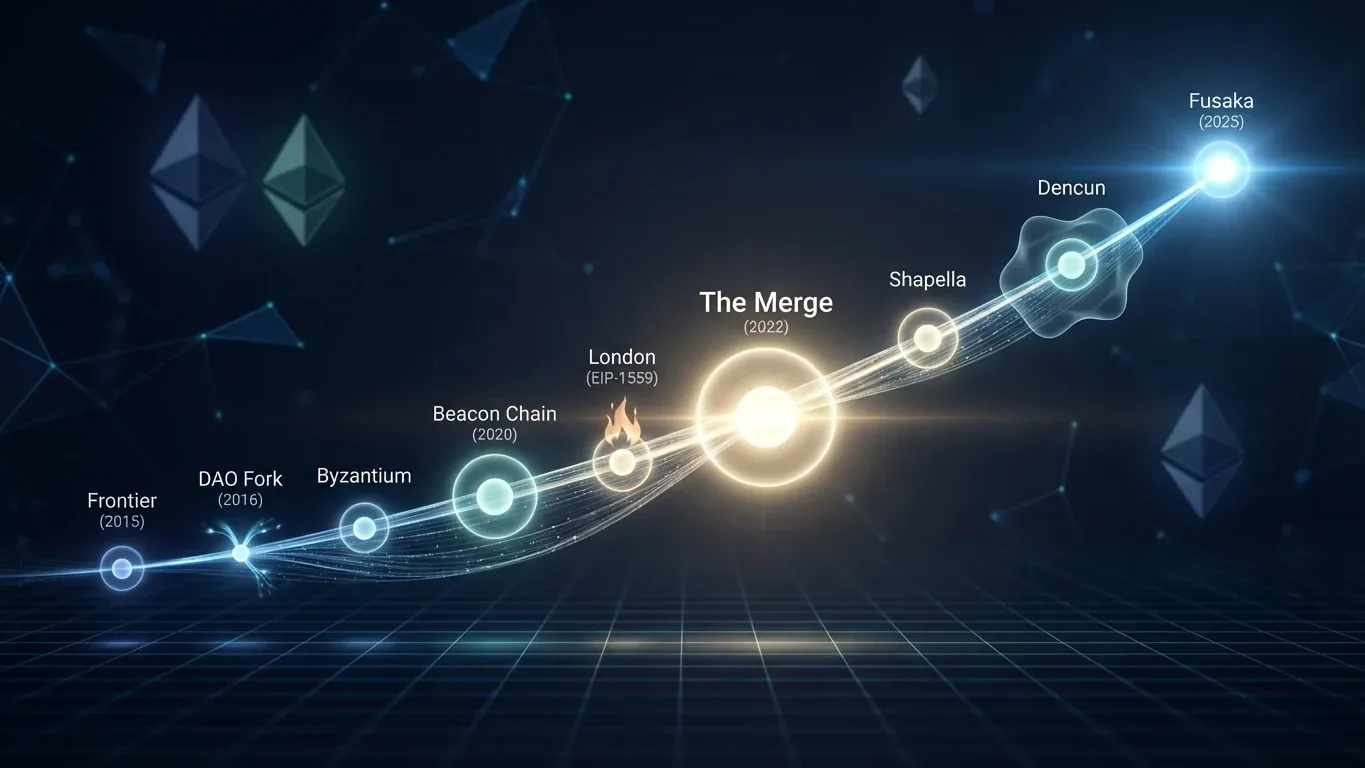
Every Major Ethereum Upgrade, Explained: From Frontier to Fusaka
From a barebone developer experiment in 2015 to a rollup-centric settlement layer processing thousands of transactions per second, Ethereum has reinvented itself more than any other blockchain. Here is the full story of how it got here.
Key Takeaways
- Ethereum has completed over 20 network upgrades since 2015, each one solving a specific technical limitation or preparing the network for its next phase of growth.
- The Merge (September 2022) remains the most significant single upgrade in Ethereum's history, switching the network from proof-of-work to proof-of-stake and cutting energy consumption by roughly 99.95%.
- The 2024 and 2025 upgrades (Dencun, Pectra, Fusaka) shifted Ethereum's strategy toward a rollup-centric model where Layer 2 networks handle most user transactions while Ethereum secures the data underneath.
- Ethereum now follows a twice-yearly hard fork schedule, with the Glamsterdam upgrade expected in mid-2026 and Hegota later that year.
- The long-term roadmap is still organized around six conceptual phases: the Merge (complete), the Surge, the Scourge, the Verge, the Purge, and the Splurge.
Why Ethereum Never Stops Upgrading
Ethereum's upgrade history spans over 20 hard forks across a decade, transforming the network from a developer prototype into the most widely used programmable blockchain in the world. At Blockready, we dedicate specific lessons in Module 2 (Blockchain Architecture) and Module 3 (Ethereum) to this upgrade timeline because understanding why each fork happened is the fastest way to understand how Ethereum actually works today.
The network launched in 2015 with a bold premise: a programmable blockchain that could run any application, not just payments. But that ambition came with a problem. The original network could handle roughly 15 transactions per second. It ran on proof-of-work mining, consuming enormous amounts of energy. And as usage grew through 2017's ICO boom and 2020's DeFi summer, the gap between what Ethereum promised and what it could deliver became impossible to ignore.
Every major upgrade exists because of that gap. The network had to become faster, cheaper, more energy-efficient, and more secure, all without breaking the thousands of applications already running on it. That constraint is what makes Ethereum's history unusual. Unlike a startup that can ship breaking changes overnight, Ethereum has to upgrade a live, decentralized system worth hundreds of billions of dollars while keeping everything running.
The process works through Ethereum Improvement Proposals (EIPs). Anyone in the community can submit one. Proposals get debated on forums like Ethereum Magicians and the EthR&D Discord, reviewed by core developers, tested on devnets and testnets, and eventually bundled into hard forks that require every node operator to update their software. Slow. Deliberate. Occasionally contentious. But it is how a decentralized network avoids having a single point of failure in its decision-making.
Building the Foundation (2015 to 2016)
Frontier, Homestead, and the Birth of a Platform
Ethereum's genesis block was mined on July 30, 2015, launching a release called Frontier. It was intentionally bare-bones: a command-line interface meant for developers, not regular users. The gas limit per block was hardcoded at 5,000, which severely limited what you could do. But it proved the concept worked. Smart contracts could be deployed and executed on a public blockchain.
A few months later, the Frontier Thawing fork lifted that gas limit and set the default gas price, making the network actually usable. It also introduced something called the "difficulty bomb," a mechanism designed to gradually increase mining difficulty until the network became unusable under proof-of-work. The idea was simple: build in a deadline that would force the eventual transition to proof-of-stake. That bomb would be delayed repeatedly over the next six years, becoming one of the recurring subplots of Ethereum's history.
In March 2016, Homestead arrived as the first planned hard fork. It stabilized the protocol, improved smart contract functionality in Solidity, and removed centralized "canary contracts" that had given the Ethereum Foundation an emergency kill switch. Ethereum was growing up.
The DAO Fork: Ethereum's Defining Governance Crisis
Then came the event that tested whether Ethereum could survive its own principles. In mid-2016, a project called The DAO raised approximately $150 million through a token sale, making it the largest crowdfunding event in history at the time. It was a decentralized investment fund built entirely on Ethereum smart contracts. In June 2016, an attacker exploited a reentrancy bug in The DAO's code and drained roughly $50 million worth of ETH.
The community faced an impossible choice. Do nothing and accept that "code is law," even when the code had a critical flaw. Or execute a hard fork to reverse the theft and return funds to their original owners, which meant overriding the blockchain's transaction history.
Ethereum chose the hard fork. On July 20, 2016, at block 1,920,000, the network split. The majority followed the new chain (which kept the Ethereum name), while a minority continued the original unforked chain as Ethereum Classic. It remains one of the most consequential governance decisions in blockchain history, and it established a precedent: Ethereum's community would prioritize pragmatic outcomes over ideological purity when the stakes were high enough.
ETHEREUM'S MAJOR UPGRADES: A DECADE OF EVOLUTION
Sources: ethereum.org, Ethereum Foundation Blog
Preparing for Scale (2017 to 2020)
Byzantium, Constantinople, and the Long Road to Proof-of-Stake
After the DAO crisis settled, Ethereum entered a multi-year phase focused on hardening the network and laying the groundwork for its eventual transition to proof-of-stake. This was the Metropolis era, and it unfolded across two main forks.
Byzantium arrived in October 2017. It introduced support for zero-knowledge proofs (zk-SNARKs), which would later become central to Ethereum's scaling strategy. It also reduced block rewards from 5 ETH to 3 ETH and delayed the difficulty bomb for another year. The reduction in block rewards was deliberate: lower mining incentives meant less resistance when the network eventually abandoned proof-of-work entirely.
Constantinople and its companion fork Petersburg shipped in February 2019. They further reduced block rewards to 2 ETH per block, optimized certain EVM operations for cheaper smart contract execution, and once again delayed the difficulty bomb. A security vulnerability discovered just before launch forced Constantinople to be postponed and patched, which is why it shipped alongside the Petersburg fix.
Istanbul followed in December 2019. It optimized gas costs for several operations, improved the network's resistance to denial-of-service attacks, and made Layer 2 scaling solutions based on SNARKs and STARKs more practical. This was the first upgrade that explicitly looked forward to a rollup-centric future, even though that term wasn't widely used yet.
Muir Glacier, a small emergency fork in January 2020, did one thing: delay the difficulty bomb again. By this point, the bomb had been pushed back four times. The joke in the developer community was that Ethereum kept writing checks it would eventually have to cash.
The Beacon Chain: Proof-of-Stake Goes Live
On December 1, 2020, Ethereum launched the Beacon Chain, a separate proof-of-stake blockchain running in parallel to the existing proof-of-work mainnet. This was the single biggest step toward the eventual Merge, and it required validators to deposit 32 ETH each to participate. The Beacon Chain didn't process any user transactions. Its only job was to coordinate validators and prove that the new consensus mechanism worked at scale.
What made this approach unusual was the patience behind it. Rather than switching consensus mechanisms in one risky move, Ethereum ran two parallel chains for nearly two years, testing and refining proof-of-stake before committing to the transition. It was the engineering equivalent of building a new engine while the plane was still flying.
The Great Transition (2021 to 2022)
Berlin, London, and the Fee Revolution
2021 brought two significant upgrades to the execution layer. Berlin (April 2021) optimized gas costs for certain transaction types and introduced new transaction envelopes that made the network more flexible for future upgrades.
London (August 2021) was far more consequential. It included EIP-1559, which completely restructured how Ethereum handles transaction fees. Before London, fees worked as a simple auction: users bid for block space, and miners kept everything. After EIP-1559, a portion of every transaction fee (the "base fee") was automatically burned, permanently removing ETH from circulation. Users could still add a "priority fee" as a tip to speed up their transactions, but the base fee mechanism made gas prices more predictable and introduced deflationary pressure on ETH supply.
EIP-1559 was controversial before launch, particularly among miners who stood to lose significant revenue. But it proved to be one of Ethereum's most important economic changes, turning ETH from a purely inflationary asset into one that could become net deflationary during periods of high network usage.
On the consensus side, the Altair upgrade (October 2021) brought validator penalties to their full values and introduced sync committees to the Beacon Chain, preparing it for the Merge. Arrow Glacier and Gray Glacier in late 2021 and mid-2022 were, predictably, difficulty bomb delays. Some traditions die hard.
The Merge: Ethereum's Biggest Bet
On September 15, 2022, Ethereum executed the Merge. The proof-of-work execution layer joined with the proof-of-stake Beacon Chain, and mining stopped permanently. It was the most complex live infrastructure migration in the history of decentralized systems.
THE MERGE BY THE NUMBERS (SEPTEMBER 2022)
Sources: Ethereum Foundation, Etherscan
Combined with EIP-1559's fee burning, Ethereum became periodically deflationary for the first time. All of that happened without a single second of downtime.
What the Merge did not do was reduce transaction fees or increase speed. That was never the goal. The Merge was about sustainability and security, switching to a consensus mechanism that didn't require the energy output of a small country. Scaling would come later, through a different set of upgrades.
The Rollup Era (2023 to 2025)
Shanghai/Shapella: Completing the Staking Story
In April 2023, the Shanghai (execution layer) and Capella (consensus layer) upgrades shipped together as "Shapella." The headline feature was EIP-4895, which finally allowed validators to withdraw their staked ETH. Until this point, staking had been a one-way door: you could deposit 32 ETH to become a validator, but you could not get it back. Some validators had locked up their ETH since the Beacon Chain launch in December 2020, over two years earlier.
Enabling withdrawals unlocked roughly $30 billion in staked ETH and removed a major barrier to staking participation. Contrary to fears of a mass exodus, most validators chose to stay. Staking became a more attractive proposition once the exit door actually existed.
Dencun: The Blob Revolution
March 2024 brought the Dencun upgrade (Deneb on the consensus layer, Cancun on execution), and it marked a turning point in how Ethereum thinks about scaling. The centerpiece was EIP-4844, known as proto-danksharding, which introduced a new data type called "blobs."
Why does this matter to you? Because blobs are what made Layer 2 networks affordable to use. They are temporary data packets attached to blocks. Layer 2 rollups use them to post compressed transaction data back to Ethereum for security, but at a fraction of the cost of regular transaction data. The impact was immediate: Layer 2 transaction fees dropped by 90 to 95% almost overnight. A transaction on Arbitrum or Optimism that previously cost $0.50 to $3.00 suddenly cost $0.01 to $0.10.
Dencun formalized Ethereum's rollup-centric roadmap. Instead of trying to scale the base layer to handle millions of transactions directly, Ethereum would focus on being the best possible data availability and settlement layer for the Layer 2 networks that handle actual user traffic.
Pectra and Fusaka: 2025's Double Upgrade
2025 was the year Ethereum shifted to a twice-yearly hard fork schedule, shipping both Pectra (May 2025) and Fusaka (December 2025). Pectra (Prague on execution, Electra on consensus) focused on user experience and validator improvements. Its headline feature was EIP-7702, which allowed regular Ethereum accounts to temporarily behave like smart contract wallets. In practical terms, this meant users could batch transactions, have someone else sponsor their gas fees, set up programmable spending controls, and use account recovery mechanisms, all without migrating to a new wallet. It also increased the maximum effective balance for a single validator from 32 ETH to 2,048 ETH (EIP-7251), making staking more capital-efficient for institutions and large holders. Blob capacity increased from a target of 3 to 6 per block.
Fusaka (Fulu on consensus, Osaka on execution) arrived in December 2025 with deeper infrastructure changes. The headline was PeerDAS (EIP-7594), a new protocol for verifying data availability. Before Fusaka, every node had to download every blob in full. After Fusaka, nodes only sample small pieces, using cryptographic techniques to confirm the data is available without storing all of it. Essential, because blob demand from Layer 2 networks was already pushing against capacity limits.
Fusaka also introduced Blob Parameter Only (BPO) forks, a mechanism that lets Ethereum adjust blob capacity between major upgrades without needing a full hard fork. The first two BPOs were scheduled immediately after Fusaka, increasing the blob target from 6 to 10, then to 14 per block. The gas limit rose from 45 million to 60 million per block, and a per-transaction gas cap of 16.7 million was added to prevent any single transaction from dominating block space.
Where Ethereum Goes From Here
The Roadmap: Surge, Scourge, Verge, Purge, Splurge
Ethereum's long-term development is organized around six conceptual phases, originally outlined by Vitalik Buterin. These are not sequential upgrades but overlapping research and development tracks. Each named hard fork (Pectra, Fusaka, Glamsterdam) typically advances multiple phases at once.
ETHEREUM'S SIX-PHASE ROADMAP
Source: ethereum.org roadmap, Vitalik Buterin's blog
Glamsterdam, Hegota, and the Road to 2027
The next named upgrade is Glamsterdam (Gloas on consensus, Amsterdam on execution), targeted for the first half of 2026. Its two confirmed headline features are ePBS (enshrined Proposer-Builder Separation), which addresses MEV centralization, and Block-level Access Lists (EIP-7928), which enable parallel transaction execution by pre-declaring which state each transaction will touch. Together, these changes could dramatically increase Layer 1 throughput while reducing gas costs. According to the Ethereum Foundation's 2026 protocol priorities update, work is organized across three tracks: scaling, improving user experience, and hardening Layer 1.
Following Glamsterdam, developers have already named the subsequent upgrade Hegota, expected later in 2026. Verkle Trees are frequently mentioned as a candidate for inclusion, which would push the Verge phase forward significantly.
At a higher level, Vitalik Buterin presented what he calls "Lean Ethereum" at both EDCON 2025 in Osaka and Devconnect in late 2025. The vision is a network that is simpler, more secure, and more resistant to future threats, including quantum computing. Priorities include single-slot finality (reducing transaction confirmation times from roughly 15 minutes to 12 seconds), stateless client architecture, enhanced privacy features through zero-knowledge proofs, and post-quantum cryptography. The Ethereum Foundation has already formed a dedicated post-quantum security team to prepare for long-term cryptographic threats.
Source: Vitalik Buterin, reported via CryptoNews
The Bigger Picture
Ethereum's upgrade history reveals a consistent pattern: each generation of improvements solves the previous generation's most pressing limitation. Proof-of-work created energy and scaling problems. Proof-of-stake solved energy but exposed MEV and centralization risks. Rollups solved fees but created interoperability challenges. Each solution creates the next set of problems, and each upgrade cycle addresses them. Understanding this pattern matters more than memorizing individual fork names, because it tells you where the network is likely headed next.
How This Shapes What You Need to Learn
Ethereum's ten-year evolution from a bare developer prototype to a rollup-centric settlement layer is one of the most complex ongoing engineering projects in the technology sector. Two more major upgrades are planned for 2026 alone, with research tracks extending years beyond that. The pace is not slowing down.
For anyone trying to understand cryptocurrency seriously, this upgrade history is the context that makes everything else make sense: why Layer 2 networks exist, why gas fees behave the way they do, why staking works the way it works, and why Ethereum's economic model keeps changing. Blockready's Module 3 (Ethereum) covers each major upgrade phase with interactive timelines, knowledge checks, and mechanism breakdowns that connect the technical changes to their real-world consequences, going deeper than any single article can. Without that deeper context, you are left reacting to headlines instead of understanding what is actually changing at the protocol level.
And that understanding is what separates someone who can evaluate an Ethereum-related investment or career opportunity from someone who is guessing.
Frequently Asked Questions
See How Ethereum Fits Into the Full Picture
Ethereum's upgrades are just one thread in a much larger story. Download the full Blockready syllabus to see how 13 modules connect blockchain architecture, consensus mechanisms, token economics, and market structure into one clear framework.
Download the Syllabus