
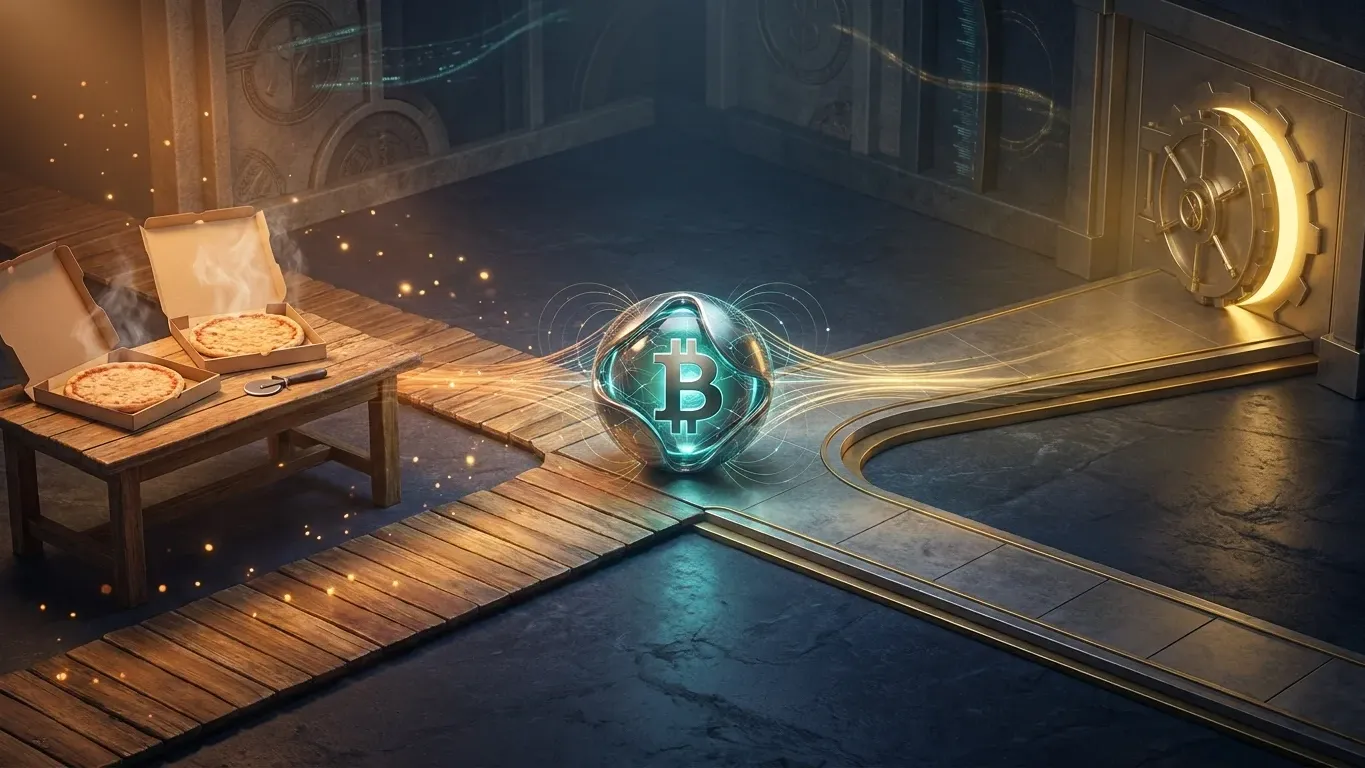
Bitcoin Pizza Day: What the First Bitcoin Purchase Actually Proved
Bitcoin Pizza Day marks the first known real-world purchase made with Bitcoin, and the story behind it explains more about how money works than the famous price tag suggests.
Key Takeaways
- Bitcoin Pizza Day is celebrated every May 22 to mark the first known commercial Bitcoin purchase, when Laszlo Hanyecz paid 10,000 BTC for two Papa John's pizzas in 2010.
- The trade mattered because it created price discovery: it gave Bitcoin its first real exchange rate against a tangible good, which every later market built on.
- Hanyecz was not a careless user. He was an early Bitcoin developer who deliberately spent coins to test whether the network could work as money.
- The "he wasted billions" framing misreads the event. Spending was the point, because an unspendable currency proves nothing.
- Pizza Day is the origin of crypto's oldest tension: whether Bitcoin is better understood as a medium of exchange or a store of value.
Bitcoin Pizza Day is an annual event held every May 22 that commemorates the first known real-world purchase made with Bitcoin, when programmer Laszlo Hanyecz paid 10,000 BTC for two pizzas in 2010. Most retellings stop at the eye-watering number and treat the day as a cautionary tale about a fortune left on the table. That framing is the most repeated and least useful thing said about the most important transaction in Bitcoin's early history. At Blockready, we use this story in our Bitcoin material because it teaches a mechanism that beginners rarely get from price-focused coverage: how a currency actually earns a price in the first place.
If you have only ever heard Pizza Day described as "the guy who spent a billion dollars on pizza," you have been handed the punchline without the lesson. The interesting part is not how much the coins are worth now. It is what the trade proved back then, and why someone who understood Bitcoin better than almost anyone chose to spend it anyway.
What Actually Happened on May 22, 2010
On May 18, 2010, Hanyecz posted an offer on the BitcoinTalk forum: he would pay 10,000 bitcoins to anyone who would get him two large pizzas. He was specific about toppings and relaxed about logistics. The counterparty could cook the pizzas or order delivery. He simply wanted to turn a balance in his wallet into food he could eat.
The post sat for four days while forum members debated whether the offer was serious. On May 22, a teenager who went by the handle "jercos," later identified as Jeremy Sturdivant, took the deal. He arranged two Papa John's pizzas to be delivered to Hanyecz's home in Florida, and Hanyecz sent him 10,000 BTC. At the time, those coins were worth roughly $41, which works out to an implied price of about $0.0041 per bitcoin. The pizzas cost more than the bitcoins.
Bitcoin Pizza Day: The Trade and What Came After
The same 10,000 BTC tells a very different story depending on the year you look at it.
Sources: BitcoinTalk forum thread (2010); CoinGecko price data, as of May 2026. Notes: dollar values are notional and move with bitcoin's price.
Why a Pizza Order Mattered More Than the Pizza
Before May 22, 2010, Bitcoin had a problem that no amount of clever code could solve on its own. It had no agreed value. A currency that cannot be exchanged for anything is just a number in a database. Hanyecz's trade changed that by doing something deceptively simple: it set a price. Once two people agreed that 10,000 BTC was worth two pizzas, Bitcoin had a reference point that the rest of the market could argue with, build on, and eventually move far beyond.
Price Discovery
Price discovery is the process by which a market settles on the price of an asset through the actions of buyers and sellers. It is how an asset goes from having no price to having a market price.
Simple version: a price does not exist until someone is willing to trade at it. The pizza deal was Bitcoin's first.
This is not an academic point. Every later piece of Bitcoin's market structure depends on the idea that the asset has a discoverable price. Exchanges quote it. ETFs track it. Lenders collateralize against it. None of that machinery works without a starting reference, and the pizza trade is the first widely cited reference on record. Understanding how a price comes into existence is also what separates someone who can evaluate a new token's claims from someone who simply repeats them, which is exactly the kind of reasoning that protects beginners from their first expensive mistake.
The Part Most Retellings Skip
Hanyecz is usually cast as a hapless early adopter who got unlucky. The record says something different. By mid-2010 he was one of the most consequential contributors in Bitcoin's small developer community. According to journalist Nathaniel Popper's account in Digital Gold, he was among the earliest developers to work directly with Satoshi Nakamoto on the software, and he built the first version of the Bitcoin client that ran on Mac computers.
His more important contribution was technical. Hanyecz was the first person to demonstrate that Bitcoin could be mined using a graphics card rather than an ordinary processor, a shift that reshaped how Bitcoin mining works and how quickly new coins entered circulation. He had accumulated his bitcoins by mining them on his own hardware when difficulty was low. So when he spent 10,000 of them on pizza, he was not gambling with money he failed to understand. He was a builder running an experiment on a system he had helped build.
That reframing matters because it changes the moral of the story. This was not carelessness. It was a deliberate test of whether a peer-to-peer network, as described in the original Bitcoin whitepaper, could function as everyday money. The test worked.
Spend It or Hold It? The Question Pizza Day Started
The reason people frame Pizza Day as a tragedy is that they are quietly applying one definition of money while Hanyecz was testing another. A medium of exchange is something you spend to acquire goods. A store of value is something you hold because you expect it to keep or grow its worth. Bitcoin is asked to be both, and those two jobs pull in opposite directions. Spending proves utility. Holding preserves wealth. You cannot fully do both with the same coin at the same moment.
Two Jobs Bitcoin Is Asked to Do
Framework: Blockready educational synthesis. Notes: simplified for beginner education; not financial advice.
One of the most common misreadings in crypto is to judge an early decision by a definition that only became popular later. The "digital gold" view of Bitcoin, where the right move is to hold and never spend, took hold years after 2010. Applying it backward to Hanyecz is like criticizing the Wright brothers for not flying transatlantic. Understanding which job you are measuring against, and being honest that the asset cannot ace both at once, is the difference between an informed view of Bitcoin and a meme. If you want to keep terms like these straight as you learn, a plain-language crypto glossary is a useful reference to return to.
Bitcoin Pizza Day: Myth vs Reality
Myth
Hanyecz threw away a fortune on pizza
This judges a 2010 decision by a price that did not exist for years and a holding strategy that was not yet the norm.
Reality
He proved Bitcoin could function as money
An unspendable currency proves nothing. Someone had to make the first real purchase, and a working network needed exactly that.
Framework: Blockready educational synthesis based on the sources cited in this article.
From Two Pizzas to the Lightning Network
Hanyecz himself never seems to have treated the trade as a regret. In 2018 he bought pizza with Bitcoin again, this time over the Bitcoin Lightning Network, paying a tiny fraction of a single coin to settle the order almost instantly. The re-enactment was not nostalgia. It was a second experiment, showing that Bitcoin's payment problem in 2010, slow and clumsy for small purchases, had a technical answer eight years later. The same instinct that produced the first pizza trade produced the second one.
That arc, from a clumsy 2010 forum barter to near-instant settlement, is exactly why Pizza Day belongs in a structured study of Bitcoin rather than a list of fun facts. Blockready's Bitcoin module covers Bitcoin's origin and purpose, its monetary design, scarcity, and historical milestones as connected ideas, because the design choices only make sense once you see the problems they were built to solve. Pizza Day is where the money question stopped being theoretical.
Our View
Based on how we sequence Bitcoin's story in our curriculum, Pizza Day is best taught as a lesson about price discovery and the spend-versus-hold tension, not as a parable about regret. The mechanism is the point: a currency earns a price only when someone trades at one, and a network only proves it is money when value actually moves through it. Read that way, Hanyecz did not make a mistake. He did the one thing the system needed in 2010, and the eye-watering valuations that came later are a consequence of that proof, not a rebuke of it.
For the broader arc of how Bitcoin grew from a nine-page paper into a multi-trillion-dollar asset, it helps to place Pizza Day inside the wider history of cryptocurrencies. And if you are still building the foundation, a clear explanation of what Bitcoin actually is gives the rest of this story its footing.
Frequently Asked Questions
What is Bitcoin Pizza Day?
Bitcoin Pizza Day is an annual event on May 22 that marks the first known real-world Bitcoin purchase. On May 22, 2010, programmer Laszlo Hanyecz paid 10,000 BTC for two Papa John's pizzas, worth about $41 at the time. It is widely seen as the moment Bitcoin proved it could function as money.
How much would the 10,000 BTC be worth today?
It depends on bitcoin's price on the day you check. With bitcoin near $77,000 on Pizza Day 2026, the 10,000 BTC would be worth roughly $770 million. At bitcoin's October 2025 all-time high near $126,000, the same coins carried a notional value of about $1.26 billion.
Who bought the pizza with Bitcoin?
Laszlo Hanyecz, a Florida-based programmer and early Bitcoin developer, made the offer and sent the 10,000 BTC. A forum user known as "jercos," later identified as Jeremy Sturdivant, accepted the deal and arranged for two Papa John's pizzas to be delivered.
Did Laszlo Hanyecz regret buying pizza with Bitcoin?
By his own public statements, no. Hanyecz has said the purchase mattered because it proved Bitcoin could be used as money, and in 2018 he repeated the experiment over the Lightning Network. He treated both trades as tests of the network, not as financial decisions to second-guess.
Why does Bitcoin Pizza Day still matter?
It matters because it was Bitcoin's first price discovery event. The trade gave the currency its first real exchange rate against a tangible good, which later markets, exchanges, and products all built on. It also began crypto's ongoing debate over whether Bitcoin is mainly a medium of exchange or a store of value.
Not Sure Where to Start?
Answer a few quick questions about your goals and experience level, and Blockready will recommend the learning path that fits you best.
Find Your Starting Point